
20 Yard Dumpster · Bloomington, IL
20 Yard Dumpster Rental in Bloomington, IL
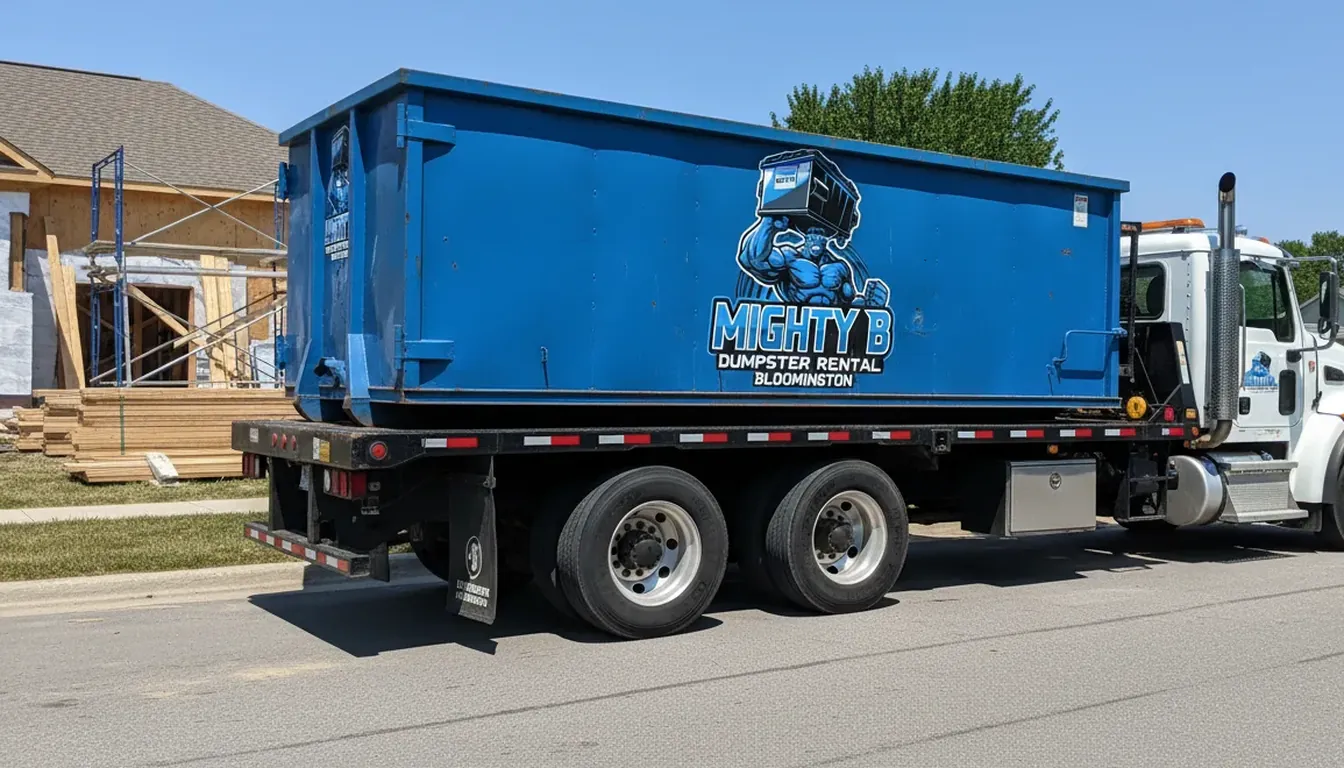
Twenty-two feet long, eight wide, four-and-a-half-foot walls, three to four tons included. This is the one that leaves our yard most days, and on most Bloomington driveways it is the right answer.
- Same-day & next-day delivery
- Flat-rate, all-in pricing
- Driveway protection included
- Same-Day DeliveryCall before noon and we can usually be there today.
- Flat-Rate PricingDelivery, pickup, disposal and tax quoted up front.
- Licensed & InsuredFully insured and licensed to haul in Illinois.
- Locally Owned2013-founded, family run, based right here in Bloomington.
At a glance
20 Yard Dumpster specifications
- Dimensions22 ft × 8 ft × 4.5 ft
- Capacity6–8 pickup loads
- Weight included3–4 tons
- Rental period7 days standard, extend any time
- DeliverySame-day or next-day across McLean County
- PricingOne flat rate — delivery, pickup, disposal & tax
If you called and described an average job without naming a size, this is what we would send. The 20 yard is the default for a reason, and it is not marketing. It is the point where volume and weight allowance line up with what a typical residential or light commercial job actually produces, on a footprint that still fits a normal driveway.
The dimensions are 22 feet long, 8 feet wide, with walls about 4.5 feet high — roughly six to eight pickup loads, with 3–4 tons included. The wall height is the detail worth dwelling on. At four and a half feet, an average adult can pick something up and put it over the side. That sounds minor until you have spent a Saturday walking every single item through a rear door and down the length of a container to stack it. A 30 yard has six-foot walls and a 40 has eight, and both of those force you into rear-door loading with a plan. The 20 lets you work from wherever you are standing.
That is why it suits the jobs that generate debris in bursts from different directions: a roof crew sliding tear-off off the eave, a cleanout crew coming out the front door and the garage side door at the same time, a remodel where the demo happens over three days and the finish trades throw packaging in on the fourth.
It is not the universal answer. Dense material — concrete, brick, dirt, tile, plaster-and-lath from the older housing stock west and south of downtown — still belongs in a 10 yard, because you would cap on tonnage in a 20 with the box a third full. And a full addition or a commercial fit-out will outgrow it. But between those, this is the box. Between those two poles, this is the box that fits.
One more thing worth knowing before you book. Standard rental here is seven days, which on a roof is more time than you need and on a house cleanout gives you two weekends if you time the delivery right. Call before noon on a weekday and same-day delivery is usually possible; otherwise it is the next morning.
Right job, right box
What this size is built for
Ideal projects
- Roof tear-off on an average Bloomington house
- Whole-home cleanout of a three-bedroom property
- Kitchen and bathroom remodel running together
- Estate cleanout including basement and garage
- Student rental turnover on an ISU or IWU lease change
- Storm debris - fence panels, siding and shed wreckage after straight-line wind
- Flooring replacement across a full main floor
- Small commercial cleanout or office clear-down
Pick a different size if…
- Clean concrete, brick, dirt or asphalt - you cap on tonnage barely a third full, use a 10 yard
- Full plaster-and-lath gut of a pre-1940 house - split it across 10 or 15 yard loads with swaps
- Room additions and new construction - a 30 yard keeps the crew out of the container
- Office or retail fit-outs with high bulky-light volume - that is a 40 yard job
- A single room of household junk - a 10 or 15 yard costs less and takes less driveway
Not sure? Call (309) 503-0748 and describe what you are looking at. We would rather sell you a smaller container than have you pay for space you do not use.
Capacity in real terms
How much actually fits
| What you're loading | How it fits in a 20 yard dumpster |
|---|---|
| Roof tear-off | About 25-30 squares of single-layer architectural shingle before weight becomes the limit |
| Whole-home cleanout | Most of a three-bedroom house including basement and garage, if you flat-pack as you go |
| Kitchen remodel | Cabinets, counters, flooring, drywall and non-refrigerant appliances with space still in hand |
| Flooring | Roughly 1,500-2,000 sq ft of carpet and pad, or 800-1,000 sq ft of tile before the weight caps out |
| Mattresses and box springs | Eight to ten sets stood on edge along the walls - lay them flat and you get half that |
| Storm debris | A yard of fence panels, siding and shed wreckage thrown straight over the side, brush handled separately |
Low walls, throw-over loading and why it matters
Container height is the specification nobody asks about and everybody feels. At 4.5 feet the top rail of a 20 yard sits around chest height on most people. You can lift a bag, a board, a bucket of tear-off or a length of trim over the side from the ground, one-handed if it is light.
Compare that to a 40 yard at eight feet. Nothing goes over that wall. Everything walks in through the rear barn doors, gets carried the length of the box, and gets stacked by hand, which is fine for a crew clearing an office with pallet jacks and a loading dock, and miserable for two people emptying a house on a Sunday.
What throw-over loading changes on a real job
- Position matters less. You can back the container up to the work rather than lining up on the doors.
- Multiple people load at once. Three people on three sides of a 20 do not queue behind each other.
- You keep the rear door for the awkward stuff. Open the doors once, walk in the appliances, the vanity and the water heater, close them, and throw everything else over the rails.
- Less handling injury. Nobody is carrying a wet sheet of drywall twenty feet into a steel box.
The trade-off is that easy loading makes it easy to overfill. Everything has to finish level with the top rail — a container heaped above the rails legally cannot be transported, and we will not take it. The fix is to load level as you go rather than building a hill in the middle and dealing with it at the end. If the last few items will not sit flat, break them down or set them aside for the next load.
Roof tear-offs: sizing by squares and layers
More 20 yards go out for roofing than for anything else. Central Illinois generates roofing work on a schedule of its own — hail in the spring, straight-line wind through the summer, the occasional derecho that re-roofs half a neighbourhood in one afternoon — and shingles behave in a specific, predictable way in a container.
Two numbers set the size. Squares (each one 100 square feet of roof) and layers. A tear-off through two layers is double the debris of one, and it is common on older Bloomington houses where a previous owner shingled over rather than stripping.
| Roof size | Single layer | Two layers |
|---|---|---|
| Up to 15 squares | 15 yard | 20 yard |
| 15-25 squares | 20 yard | 20 yard plus a swap |
| 25-30 squares | 20 yard, watch the weight | Two 20 yard loads |
| Over 30 squares | Two 20 yard loads | Staged swaps |
Note what the table does not do: it never sends a big shingle job to a 30 or a 40. Shingles are dense enough that a 30 full of tear-off is over weight, so you split the job into two 20s instead of one oversized box. The same logic applies to any heavy material.
On the day
Set the container on the side of the house the crew is stripping first, close to the eave, on protection boards. Tarp it if the job runs overnight — soaked felt and shingles carry real added weight, and so does snow. Sweep for nails before we come back. Our roofing dumpster service and the detailed tear-off sizing guide go further into staging multi-day roofs.
Whole-home cleanouts and estate work
The other job the 20 was made for is emptying a house. Downsizing, an estate, a rental turnover after a long tenancy, a hoarding situation being worked room by room — the common thread is bulky, light, awkward material coming from every part of the building at once.
A three-bedroom Bloomington home cleared completely, including closets, the basement and the garage, generally lands inside one 20 yard if the crew flat-packs as they go. Furniture on its side, drawers pulled and filled, bookcases nested, mattresses stood on edge along the walls rather than laid flat. Lay mattresses down and three of them will eat a third of the box.
Pull these out before anything goes in
- Electronics — televisions, monitors, computers, printers and peripherals are banned from Illinois landfills and must be recycled separately.
- Appliances with refrigerant — fridges, freezers, window units and dehumidifiers need professional recovery first.
- Tyres, lead-acid batteries, used oil and filters, propane tanks, liquids, wet paint and solvents. Latex paint only goes in once it is fully dried out with the lid off.
- Yard waste — grass, leaves, brush and branches have been banned from Illinois landfills since 1990 and go to composting.
Practically, run one room at a time and finish it. Set a staging line in the driveway with three piles: container, donate, restricted. The restricted pile is always bigger than people expect in a house that has been lived in for forty years. Our estate cleanout service covers the situations where the family is out of town and somebody has to empty a house on a deadline, and it lays out an order of attack that keeps two or three people busy without tripping over each other.
Why most Bloomington driveways take a 20 comfortably
Twenty-two feet of container plus the truck needs roughly 60 feet of straight approach and about 23 feet of vertical clearance for the hoist. That sounds like a lot written down. In practice, a standard Bloomington driveway from the apron to the garage door runs longer than that, and the newer east-side subdivisions along the Hershey Road and Veterans Parkway corridor are wide, straight and completely clear overhead.
The places that need a look first are the pre-1940 streets west and south of downtown: single-width drives, mature trees arching over the pavement, detached garages set back behind the house, and service drops crossing the yard at a height nobody thought about in 1926. A 20 often still fits there — it is the 30s and 40s that get ruled out — but walk it before you book.
Quick site check
- Pace the run from the street to where you want it. Roughly 20 normal paces is 60 feet.
- Look up along the whole run, not just at the drop point. Branches, cable and phone lines, carport roofs.
- Clear vehicles, trailers, boats and the basketball hoop out of the run entirely.
- Tell us about soft ground, a cracked apron or a settled slab. Every residential drop gets protection boards, but we would rather know.
- Spring thaw: keep it on pavement. Saturated prairie clay will not carry a loaded truck in March.
- Hot July afternoons soften blacktop — ask for a morning delivery.
Permits are a separate question and only come up if the container has to sit on a public street rather than private property. That is a city matter; check the City of Bloomington for current requirements. Driveway questions are covered in our driveway protection guide. If you are unsure, call (309) 503-0748 and describe the property.
Side by side
Compare with the other sizes
| Size | Dimensions (L × W × H) | Holds About | Weight Allowance | Best For |
|---|---|---|---|---|
| 10 Yard Dumpster | 12 ft × 8 ft × 3.5 ft | 2–3 pickup loads | 1–2 tons | Small cleanouts, single rooms, concrete |
| 15 Yard Dumpster | 16 ft × 8 ft × 4 ft | 4–5 pickup loads | 2–3 tons | Garage clearouts, small remodels, decks |
| 20 Yard Dumpster | 22 ft × 8 ft × 4.5 ft | 6–8 pickup loads | 3–4 tons | Whole-home cleanouts, roof tear-offs, kitchens |
| 30 Yard Dumpster | 22 ft × 8 ft × 6 ft | 9–12 pickup loads | 4–5 tons | Large remodels, construction, estate clearances |
| 40 Yard Dumpster | 22 ft × 8 ft × 8 ft | 14–16 pickup loads | 5–6 tons | Commercial jobs, bulky light debris, big builds |
Book a 20 yard dumpster in Bloomington
Call (309) 503-0748 for a flat rate and a delivery slot — often the same day.
Answers
20 Yard Dumpster — frequently asked questions
Why do you call the 20 yard the default size?
Because it matches the widest range of real jobs. Six to eight pickup loads with three to four tons included covers most roofs, remodels and house cleanouts without wasting volume, and the four and a half foot walls let you throw material over the side instead of walking every piece through the rear doors. It also fits comfortably on the great majority of driveways in Bloomington and Normal.
How big a roof will a 20 yard take?
Roughly 25 to 30 squares of single-layer shingle, or about 15 squares if you are tearing through two layers. Shingles are dense, so you will meet the weight allowance while the container still looks like it has room. On larger or multi-layer roofs we stage two 20 yard loads rather than sending a 30, because a 30 full of tear-off would be over legal haul weight.
Can I put concrete in a 20 yard?
Small amounts mixed through a general load are usually fine, but a container of masonry is not. Concrete, brick, block and dirt weigh so much per cubic yard that you would reach the legal limit with the box roughly a third full. For those loads we send a 10 yard and mark a fill line, which is both cheaper and the only way the truck can legally take it away.
Will a 20 yard damage my driveway?
We put protection boards under every residential drop, which spreads the load across the pavement rather than concentrating it on the container rails. Tell us about cracked aprons, settled slabs or newly sealed blacktop before delivery. On hot, humid July afternoons asphalt softens, so a morning delivery is better. In the March and April thaw, keep the container on pavement and off saturated lawn.
How long do I get to keep it?
The standard rental is seven days and it can be extended if the job runs long. For a roof that is usually more than enough, and for a house cleanout it gives you two weekends if you time delivery right. If you fill it early, call and we will swap it for an empty one. Reach us before noon on a weekday and same-day delivery is often possible.
Compare
Other container sizes
Services
Popular services using this size
Verified sources
Local & Official Resources
We are a private hauler, not a government agency. For rules, fees and hours, always go straight to the source:
- City of Bloomington — permits, right-of-way, refuse & recycling for Bloomington addresses
- Town of Normal — the Town of Normal runs its own separate programmes and permits
- McLean County — county services for unincorporated McLean County
- Ecology Action Center — McLean County recycling and household hazardous waste information hub
- Illinois EPA waste management — Illinois landfill bans and waste regulation
- JULIE / Illinois 811 — call 811 before any digging or footing work