
Sizing
What Size Dumpster Do I Need? Bloomington IL Guide
Most people size a dumpster on volume when weight is what decides the flat rate. Here is how all five roll-off sizes really behave on Bloomington-Normal jobs.
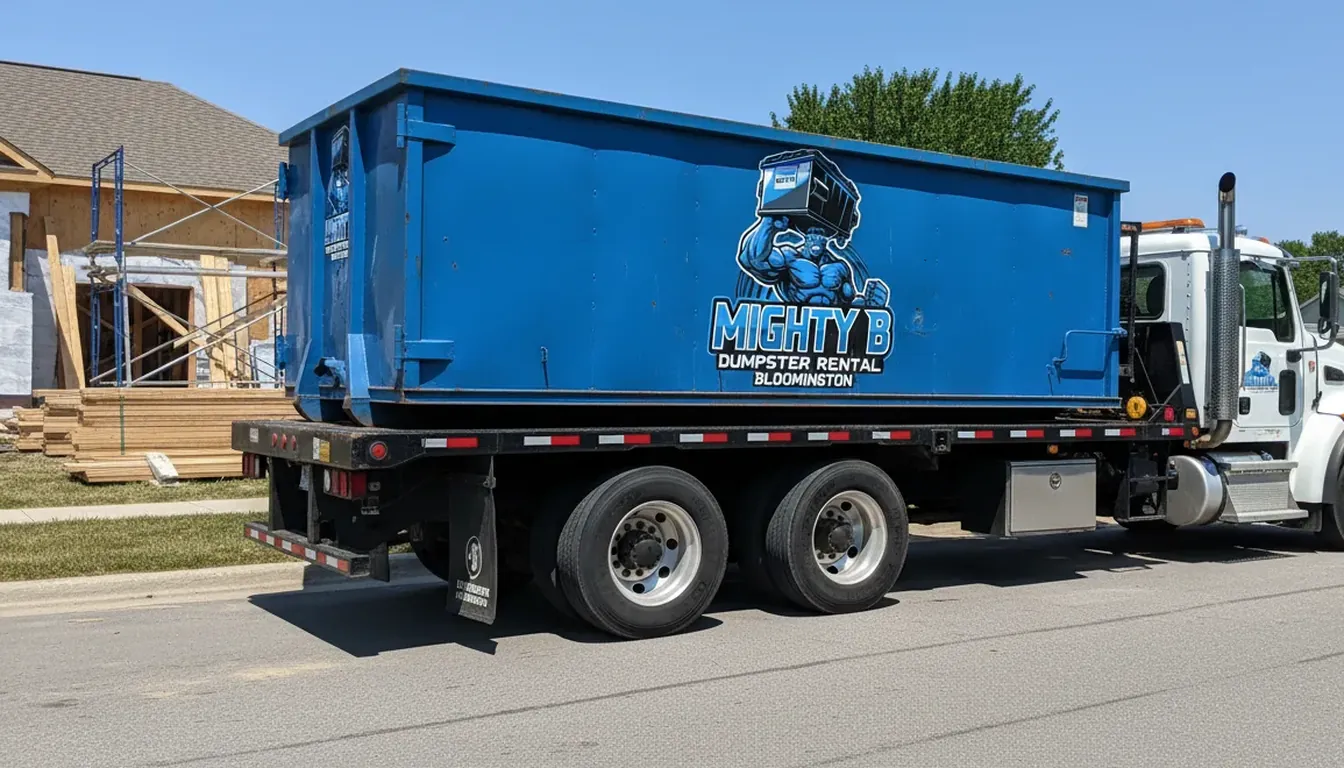
"What size dumpster do I need?" is the question we get more than any other, and it is almost always the wrong first question. The better one is "how heavy is the stuff I am throwing out?" We have been dropping roll-offs around Bloomington and Normal since 2013, and the jobs that go sideways are hardly ever the ones where somebody misjudged cubic yards by a little. They are the ones where somebody put plaster, brick and old tile into a 30 yard container, filled it a third of the way up, and found the box was effectively full.
So this guide handles both ceilings — space and weight — on Bloomington driveways, with Bloomington housing stock. By the end you should be able to pick your size in about a minute, or at least tell us enough on the phone that we can pick it for you.
Every container has two ceilings, and only one of them is visible
The first ceiling is volume: cubic yards, the size of the hole. Everybody thinks about that one, because you can see it. The second is weight. Our pricing is flat rate — delivery, pickup, a weight allowance, disposal and tax as one number — and that allowance is a real tonnage figure, because the landfill weighs the truck coming in and going out. Go past the included tonnage and the disposal cost goes past the flat rate. Nothing sneaky about it; it is physics and a scale.
Which ceiling you hit first is decided entirely by what you are loading:
- Light and bulky debris — furniture, mattresses, cardboard, carpet and pad, insulation, deck boards, vinyl siding, fence panels, cabinets, household clutter. This runs out of space long before it runs out of weight. You will be standing on it stomping it down while the scale ticket comes back well under your allowance.
- Dense debris — plaster and lath, brick, block, concrete, asphalt shingles, tile, dirt, sod, gravel, and anything pulled out of a basement that sat in water. This runs out of weight while the container still looks half empty.
If you remember one sentence from this page, make it this one: size up on volume for light debris, and size down on volume while budgeting up on weight for dense debris. People do the opposite constantly — they see a heavy job, panic, and order the biggest box on the lot, which does not buy them one extra pound of allowance.
The five sizes, with real numbers
Here is the full lineup. Dimensions are nominal outside measurements — close enough to plan a driveway, not to the quarter inch. Pickup loads assume a standard half-ton bed filled level, which is how most people actually picture volume.
| Size | Footprint (L x W x H) | Pickup loads | Typical weight allowance | Loading style | Best suited to |
|---|---|---|---|---|---|
| 10 yard | 12 x 8 x 3.5 ft | 2-3 | 1-2 tons | Low walls, easy throw-over | Heavy debris, concrete, small tear-offs, tight drives |
| 15 yard | 16 x 8 x 4 ft | 4-5 | 2-3 tons | Low walls, easy throw-over | Single-room gut, small remodel, mixed heavy and light |
| 20 yard | 22 x 8 x 4.5 ft | 6-8 | 3-4 tons | Low walls, easy throw-over | The all-rounder: garages, basements, roofs, remodels |
| 30 yard | 22 x 8 x 6 ft | 9-12 | 4-5 tons | Tall walls, rear door in | Whole-home cleanouts, larger remodels, storm debris |
| 40 yard | 22 x 8 x 8 ft | 14-16 | 5-6 tons | 8 ft walls, rear door only | Bulky light commercial volume, nothing dense |
Look at the footprint column again, because it surprises people: the 20, the 30 and the 40 all sit on the same 22 by 8 foot patch of driveway. Going bigger past 20 yards does not cost you ground space — it buys wall height, and wall height is a mixed blessing.
The 40 yard, honestly
We rent 40 yard containers and we are glad to bring you one — but we would rather put you in the right box than the biggest one, so here is the straight version.
The 40 is the same 22 by 8 foot floor as the 30. The extra ten cubic yards is two more feet of wall, and that is all it is. Nothing goes over the side of an eight-foot wall — not a sheet of plywood, not a bag of insulation, certainly not a sofa. Every item walks in through the rear swing door, so you need clear ground behind the container, and loading runs slower than people expect.
The 40 exists for one honest reason: large volumes of bulky, light material. Commercial and warehouse cleanouts, office furniture and cubicles, retail fixtures and shelving, mountains of cardboard, big siding or fence jobs — loads where you genuinely run out of space at 30 yards and are still nowhere near the tonnage.
For construction debris, roofing tear-off or anything masonry, the 40 is almost always the wrong call. You hit the tonnage cap long before you fill it, and you have paid for headroom you physically cannot use. We have watched a 40 come back from a roof job half full and heavy enough that the driver took it slow leaving the drive. A pair of smaller boxes would have been cheaper and faster to load. And an eight-foot wall on a narrow older Bloomington street is often the difference between a clean delivery and no delivery at all.
Why the 20 yard is the size we drop most
If you called and said nothing but "I am cleaning out my house," we would put a 20 yard on the truck, and we would be right most of the time.
The reason is wall height: four and a half feet. An average-height person can put a bag of drywall scrap or a chunk of decking over that rail without a ramp, without walking around to the back door, and without a second person. Loading speed on a weekend project is set almost entirely by how far you carry each item, and low walls let you throw over the nearest side. The 20 also takes 3 to 4 tons, which covers a startling number of residential jobs outright.
The 30 is the right step up when you genuinely have volume — a full house, a wind-and-hail event that stripped siding and fencing across the lot, a big addition. Just expect to walk material in through the rear door far more often.
Pre-1940 Bloomington: plaster and lath will beat you
This one is specific to our town and it costs people real money every month. The older neighborhoods west and south of downtown Bloomington are full of pre-1940 homes, and those walls are not drywall. They are wood lath nailed to the studs with three coats of plaster troweled over — a sand-and-lime base coat that is dense, brittle and heavy.
Plaster and lath runs roughly two to three times the weight of the same area of modern drywall. A room you would have gutted into a 20 yard container without a second thought in an east-side 1990s subdivision can put you at your tonnage cap in a 15 in a 1910 foursquare on the west side. Add the cast-iron radiators, the old tile, the boiler pipe and the full basement those houses come with, and the weight adds up fast.
The move is counterintuitive but correct: size down on volume, budget up on weight. Tell us it is a plaster house before we load the truck, and we will bring a smaller box with a realistic tonnage figure, or set up a swap so you run two lighter loads instead of one overweight one. Our pricing page covers how the weight allowance sits inside the flat rate.
Can the truck actually get in? The access maths
The largest container that fits your job is not always the largest that fits your street. A roll-off truck does not place a box, it rolls it off the back while moving forward, and that needs room in a straight line.
- About 60 feet of straight approach for a 20, 30 or 40 — truck, container, plus room to pull ahead as the box comes off the rails. A 10 yard is forgiving and usually sets in around 30 feet of total run.
- About 23 feet of vertical clearance at the drop point. The hoist goes way up before the container comes down. This is the one people forget, and in Bloomington it is the one that bites, because the older streets have magnificent mature trees and low service drops running to the house.
- Roughly 10 to 12 feet of width, so the driver has margin and so you can walk both sides once it is down.
Practically: narrow drives, overhanging silver maples and low utility lines on the pre-war streets rule out 30s and 40s at a fair number of Bloomington addresses. The newer east-side subdivisions off Hershey Road and the Veterans Parkway corridor are generally wide open and take anything. Farm properties out in the villages have room to spare — but check the gravel lane after a thaw, because saturated clay in March and April will not hold a loaded truck the way frozen February ground does.
If the container has to sit on a public street or in the right of way rather than on private property, that is a permit conversation, and a municipal one. Check with the City of Bloomington or the Town of Normal before delivery day rather than after.
Fill it level with the top rail. Not a bit over.
The debris has to sit level with or below the top rail, all the way around. That is not a preference, it is a transport rule: a load heaped above the rail cannot be tarped, and an overheight load legally cannot go down the road. If the driver arrives and the box is crowned like a scoop of ice cream, either you pull material off or the truck leaves empty.
Two Central Illinois wrinkles. An open container collects weather — spring rain or wet snow soaking into carpet, drywall and cardboard adds real tonnage you never loaded, so keep a tarp on it if the forecast turns. And load flat and heavy first: sheet goods, plywood, doors and mattresses laid on the floor of the box kill the air gaps, where bulky odd shapes thrown in first can cost you a third of your capacity to voids.
Project to size, at a glance
| Project | Start here | The thing that changes the answer |
|---|---|---|
| Single room declutter, small bath refresh | 10 yard | Cast-iron tub or tile floor pushes weight up fast |
| Garage or basement clean-out | 15-20 yard | Flood-soaked contents weigh several times dry ones |
| Kitchen remodel, cabinets and counters | 15-20 yard | Stone countertops alone can eat a ton of allowance |
| Roof tear-off, up to 15 squares | 10 yard | Shingles are pure weight; volume is never the limit |
| Roof tear-off, 15-30 squares | 15-20 yard | A second layer roughly doubles the tonnage |
| Whole-home cleanout, 3-4 bedrooms | 20-30 yard | Furniture-heavy means volume, estate-heavy means weight |
| Large remodel or addition | 30 yard | Plaster-and-lath home? Drop to a 20 and plan a swap |
| Commercial or office cleanout | 30-40 yard | The one job where a 40 genuinely earns its keep |
| Concrete, brick, dirt, sod | 10 yard, clean load | Keep it separated; never combine it with mixed trash |
If roofing is your project, the square-count maths is unforgiving and we walk through it properly in our roofing tear-off sizing guide.
Two 20s versus one 40
Same nominal volume, very different jobs. Two 20 yard containers — side by side, or one box swapped out — give you two separate weight allowances and low walls you can throw over from any side. If your debris is dense this is not a close call: two loads mean two tonnage allowances, and one 40 gives you exactly one.
One 40 yard container wins when the material is light and bulky, the site has room, and a crew would rather load continuously than stop and wait for a truck.
A swap-out schedule beats a bigger box more often than people expect. If the driveway will only take a 20, if the debris is heavy, if the job runs past a week, or if you want the site clean at the end of each phase, book the container plus a scheduled swap. Demolition first with the heavy box, finish materials second with the light one, and you never have to guess.
Have these five things ready when you call
Give us these and we will size the job on the phone in about a minute:
- What the debris actually is. Not "junk" — say roofing, plaster, furniture, concrete, storm debris, whole-house mixed.
- Rough scale. Square footage, rooms, or roof squares. A photo texted over beats any description.
- Age of the house. This is the plaster-and-lath question, and it changes the answer.
- Where it goes. Driveway, street, gravel lane or behind the shop — plus anything overhead: trees, wires, eaves, basketball hoop.
- Your timeline. Standard rental is 7 days and extendable, and if you call before noon on a weekday we can usually deliver the same day. Otherwise it is the next morning.
Some things never belong in the box whatever size you pick: electronics, landscape waste, tires, batteries, appliances holding refrigerant, liquids and wet paint. Those move through separate Illinois channels, and the Ecology Action Center in Normal is the place to check what goes where in McLean County.
Not sure? Just describe the pile. Call Mighty B Dumpster Rental Bloomington at (309) 503-0748 and we will tell you honestly which of the five to take — including when the smaller one is the smarter buy. Every residential drop goes on driveway protection boards, and you can also reach us through our contact page.
Need a container in Bloomington or anywhere in McLean County? Call (309) 503-0748 and describe the job. We will name the size, the flat rate and a delivery slot — often the same day. No forms, no waiting on an email.