
Roofing
Roofing Tear-Off Dumpster Sizing by Squares
Roofing is weight-limited, never volume-limited, so the right container is smaller than you think. Size a tear-off by squares and layers, the way your roofer does.
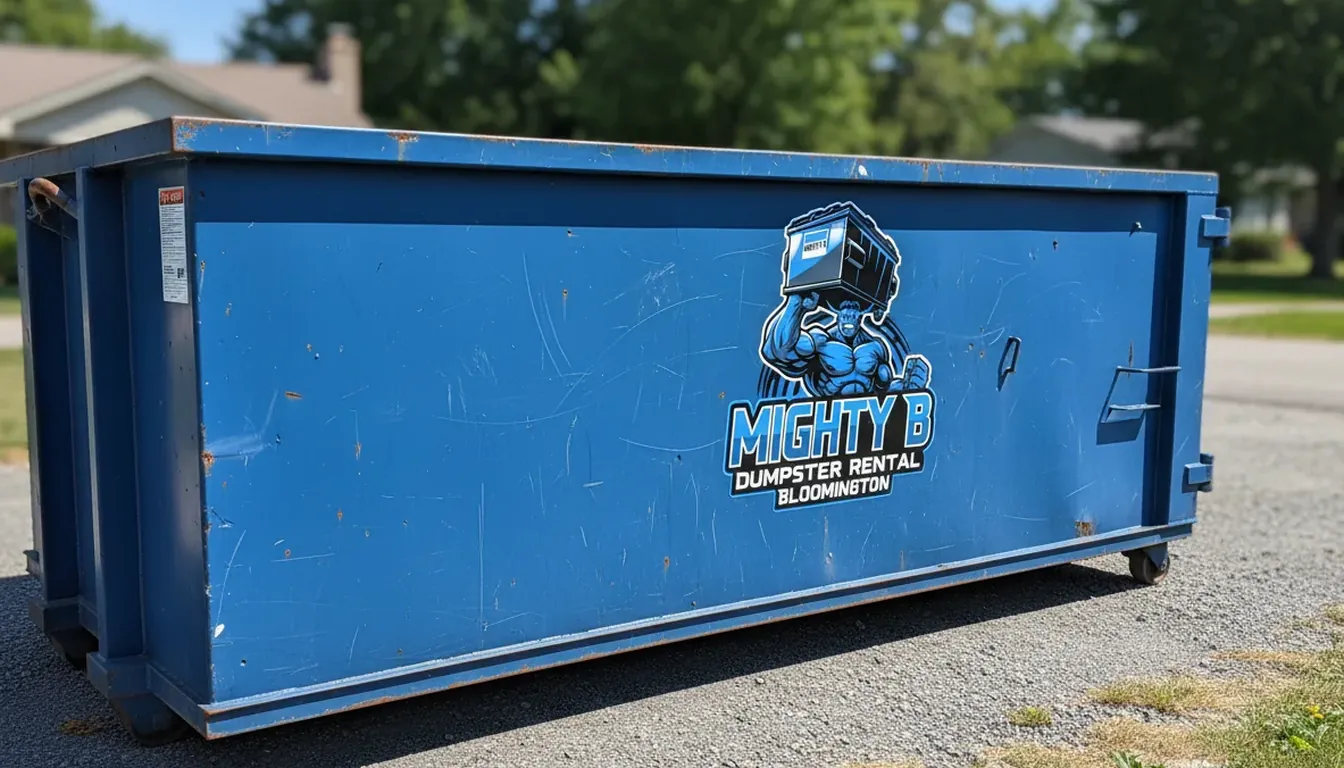
Roofing is the one job where almost everybody orders the wrong container, and they nearly all err the same direction — too big. Somebody looks at a two-storey house, pictures the pile of shingles coming off it, and asks for a 40 yard. Shingles do not behave like the rest of the debris we haul. They are dense, they stack flat, and they run out of tonnage while the box still looks like it has room for another roof.
We have been dropping roofing containers around Bloomington and Normal since 2013, through more hail seasons than we care to count. Here is how to size a tear-off properly, in the same units your roofer already thinks in.
What a square is, and how to work out how many you have
A square is 100 square feet of finished roof surface. It is the trade unit for everything — material, labour, tear-off, disposal. A bundle of asphalt shingles covers roughly a third of a square, so three bundles to the square. If you have a bid in hand, the square count is on it.
If you are estimating it yourself, start from the footprint, not the roof. Measure the outside of the house at ground level, length by width, and add the overhang — usually a foot to eighteen inches on each side, so add roughly two to three feet to each dimension. That gives you the plan area the roof covers. Then multiply by a pitch factor, because a sloped roof has more surface than the ground it shades:
- 4/12 (a shallow ranch) — multiply by about 1.05
- 6/12 (very common on Bloomington housing stock) — about 1.12
- 8/12 — about 1.20
- 12/12 (a steep older gable west of downtown) — about 1.41
Divide the result by 100 and you have squares. A 30 by 45 foot house with normal overhangs is roughly 33 by 48, call it 1,584 square feet of footprint; at a 6/12 pitch that is about 1,773 square feet, or roughly 18 squares. Add a couple of squares for hips, valleys, dormers and a detached garage if it is coming off in the same job. Most single-family homes in the Twin Cities land between 15 and 30 squares.
Weight per square is the whole ballgame
Once you know your squares, the sizing question becomes arithmetic. Every material has a fairly tight weight band per square, and tear-off debris runs a little heavier than the shingle spec sheet because the old felt, the nails and the accumulated grit come off with it.
| Roofing material | Tear-off weight per square | 20 squares, one layer | Notes |
|---|---|---|---|
| 3-tab asphalt | 200-250 lbs | 2-2.5 tons | The flat, single-thickness shingle. Standard on 1970s-1990s builds |
| Architectural / dimensional asphalt | 350-450 lbs | 3.5-4.5 tons | Laminated, two layers bonded. Nearly double a 3-tab. The default today |
| Premium / designer laminate | 450-550 lbs | 4.5-5.5 tons | Thick impact-rated and shake-look products |
| Cedar shake or shingle | 350-500 lbs | 3.5-5 tons | Light dry, far heavier if it has been holding water |
| Clay tile | 600-1,000 lbs | 6-10 tons | Rare here, but brutal on tonnage. Plan a swap-out |
| Concrete tile | 900-1,200 lbs | 9-12 tons | Treat as a masonry job, not a roofing job |
| Slate | 800-1,500 lbs | 8-15 tons | Old churches and civic buildings. Multiple small boxes, always |
| Add: 15 lb felt underlayment | 15-20 lbs | +0.2 tons | Small, but it is never zero |
| Add: ice-and-water shield | 45-60 lbs | varies | Only on the eaves and valleys, but it is rubberised and heavy |
| Add: 1/2 inch OSB decking | 140-160 lbs | +1.5 tons if fully redecked | Plank decking runs heavier still |
Now the part that catches people: layers multiply. Illinois practice for decades was to shingle over a sound existing roof rather than tear it off, so a great many houses here carry two layers and a fair number carry three. A second layer of architectural shingle does not add a little to your load. It roughly doubles it. A third roughly triples it. If your roofer says "there is another layer under this," your tonnage estimate just changed more than any other factor on the job will.
You will not always know until the first bundle comes off. If the eave detail looks thick or built up, budget for two layers and be pleasantly surprised.
Why roofing is always weight-limited and never volume-limited
Every roll-off has two ceilings: cubic yards and tons. Which one you hit first depends entirely on what you load. Tear-off shingles hit the tonnage ceiling every single time, and it is not close.
Run the numbers. A square of tear-off debris, tossed in loose rather than stacked, occupies something like five to eight cubic feet. Call it four or five squares per cubic yard. That means a 20 yard container would swallow something like ninety squares by pure volume — and at architectural weights, ninety squares is eighteen tons. No truck on our lot is taking that, and no landfill scale is going to pretend otherwise.
So the practical rule for roofing: a properly loaded roofing container looks underfilled. Two feet of shingles in the bottom of a 20 yard box is a finished job, not a wasted rental. If your container is more than half full of nothing but tear-off, something has gone wrong — either you have far more roof than you thought, or you are over on weight and do not know it yet.
Sizing table: squares by layers
This assumes architectural shingles, which is what most reroofs come off as now. If you are tearing off 3-tab you can usually drop one row lighter. If you are tearing off premium laminate, or the deck is coming off too, move one row heavier.
| Roof size | Tear-off weight, one layer | One layer | Two layers | Three layers |
|---|---|---|---|---|
| Up to 10 squares | ~2 tons | 10 yard | 15 yard | 20 yard |
| 11-15 squares | 2-3 tons | 15 yard | 20 yard | 30 yard |
| 16-20 squares | 3-4 tons | 20 yard | 30 yard | 30 yard + second pull |
| 21-30 squares | 4-6 tons | 20-30 yard | 30 yard + second pull | Two containers, staged |
| 31-40 squares | 6-8 tons | 30 yard | Two containers, staged | Two containers, staged |
| Over 40 squares | 8 tons and up | 30 yard + second pull | Two containers, staged | Talk to us first |
"Second pull" and "staged" mean the same practical thing: we take a full box away mid-job and bring an empty one back, so the crew never stops shovelling. The tonnage is the tonnage no matter how you divide it up, and a half-loaded box the driver can actually lift beats one he cannot.
Shake, slate and tile are a different job
Cedar shake, slate and tile are not roofing jobs from a container point of view — they are heavy-debris jobs, and they get sized like concrete. Slate will fill a tonnage allowance with a layer you could step over. If you are touching one of the old slate roofs around downtown Bloomington, we want smaller boxes and more of them: a 10 yard with low walls is easier to load and it is the only size we can reliably lift when it is full of stone.
The extras that blow the estimate
The shingle weight is the part everybody calculates. These are the parts nobody does:
- Old felt and underlayment. Modest per square, but it is a full extra layer of material and it comes off soaked if the tear-off catches rain.
- Ice-and-water shield. Rubberised membrane at the eaves and valleys. It is heavy, it does not tear cleanly, and on a house with long eaves it is a real number.
- Decking replacement. The single biggest surprise. Redecking even a third of a roof adds hundreds of pounds per square, and a fully redecked 20 square roof adds well over a ton. On older west-side houses with plank decking rather than sheathing, more still.
- Ridge vents, flashing, drip edge and pipe boots. Light individually, but metal is dense and it all goes in the box.
- Nails. A reroof pulls tens of thousands of them, and they end up everywhere — more on that below.
- Rain and snow. An open container left uncovered through a Central Illinois downpour gains real weight, and shingle debris holds water. If the box sits over a wet weekend, that is tonnage you are paying for.
Place the container for the shovel line
This is worth more to your crew than any other decision you make. A tear-off is done with flat shovels off the roof plane, and the ideal is that debris leaves the roof and lands in the container without a human carrying it. Park the box at the far end of the driveway and the crew ends up wheelbarrowing loads across the yard for hours.
Tell us which slope is coming off first and we will spot the container tight to that eave — usually within a few feet of the drip line, on the gable end or along the longest run. Then:
- Take the gutters off first if they are staying, or accept they will be damaged. Shingles sliding off a roof edge destroy gutter and fascia.
- Lay plywood or OSB against the house wall and over any shrubs, AC condenser or window wells in the fall zone. Sheets leaned at an angle from the eave into the container act as a chute and dramatically reduce spill.
- Protect the driveway apron. The apron where concrete meets the street takes the worst of any truck movement. We put driveway protection boards under every residential drop as standard — there is more detail in our guide to protecting your driveway during a delivery. On a soft July afternoon when the asphalt has gone tacky, take the morning slot.
- Keep off the lawn in March and April. Our clay soil holds water and a loaded roll-off will sink and rut. Frozen ground in January is fine; saturated ground in spring is not.
Storm waves, and why timing matters here
This is hail and straight-line wind country. One severe afternoon across McLean County can generate hundreds of claims, and the reroofs that follow arrive in a wave four to eight weeks later, once adjusters have worked through the neighbourhood. During those weeks roofing containers get genuinely tight across the Twin Cities. If your claim is approved, call for your container the day you schedule your roofer, not the day before. Our storm damage cleanup guide covers the wider debris picture.
Ordinary scheduling: have the box land the evening before. Roofing crews start at first light in summer to beat the heat, and a container that shows up at ten in the morning has already cost you a third of a day. Same-day delivery is available if you call before noon on a weekday, but for a tear-off we would rather set it the night before and have it waiting.
Magnetic sweep before we pull it
Nails are the part of a reroof that outlasts everything else. A rolling magnetic sweeper over the driveway, the apron, the parkway strip and the lawn perimeter takes fifteen minutes and saves tyres, bare feet and mower blades for years. Do it before we come for the box, not after — the container itself hides a strip of ground, and there is always a line of nails under where it sat. Good roofers do this automatically; ask, and watch it happen.
Asphalt shingles are recycled into road material in some markets; the Ecology Action Center in Normal is the place to ask what is currently accepted in McLean County, and the US EPA has background on construction and demolition material generally. Placing the box on a public street rather than a driveway? Check with the City of Bloomington first.
Why the 40 yard is the wrong answer for shingles
The 40 yard sits on exactly the same 22 by 8 foot patch of driveway as the 30. The extra ten cubic yards is two more feet of wall height, nothing else. For a tear-off that is worse than useless: you cannot throw shingles over an eight-foot wall from ground level, the extra headroom is space you will never come close to using, and the tonnage allowance is not dramatically bigger than a 30. You end up paying for air.
The 40 earns its keep on bulky light loads — commercial cleanouts, cardboard, furniture, siding, fencing. On roofing it is a false economy: it looks like more value per dollar and delivers less usable capacity than two smaller boxes. If somebody is steering you to a 40 for a shingle job, ask what the weight allowance is.
Tell us your squares and your layers and we will pick the box. If you do not know the layer count, tell us the age of the house and the year of the last roof and we will make a sensible call, then adjust on the fly if the first slope reveals a surprise. Call Mighty B Dumpster Rental Bloomington at (309) 503-0748 or use our contact page. Flat rate, one number, delivery and pickup and disposal included — and we will set it where your shovel line wants it, the evening before your crew arrives.
Need a container in Bloomington or anywhere in McLean County? Call (309) 503-0748 and describe the job. We will name the size, the flat rate and a delivery slot — often the same day. No forms, no waiting on an email.