
Permits & Placement
Will a Dumpster Wreck My Driveway? Honest Answer, IL
The rollers, not the box, are the pressure point. What protection boards really do, how each driveway surface fails, and when a Bloomington driveway is a bad bet.
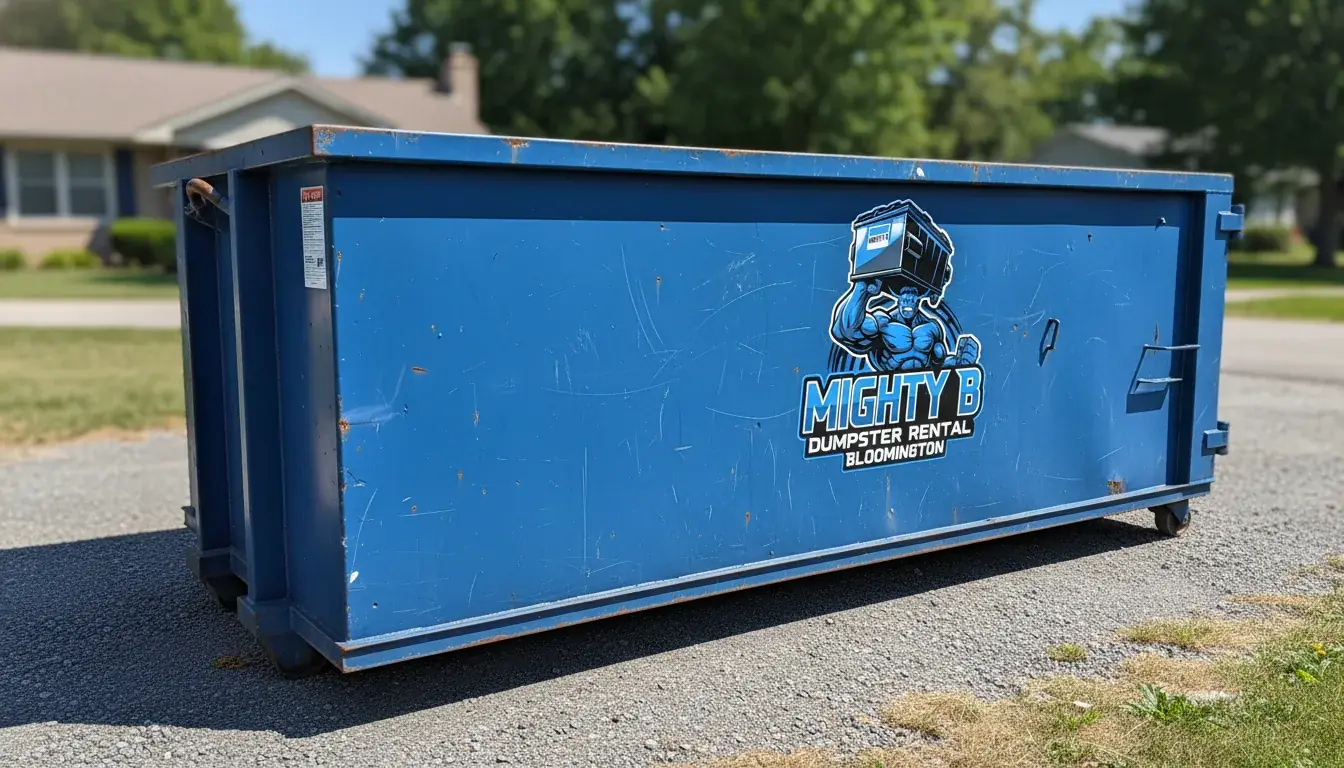
It is the question we field most, usually in a slightly nervous voice: is that thing going to wreck my driveway? Honest answer, from a family outfit setting roll-offs down in McLean County since 2013 — for most driveways in Bloomington–Normal, no. But most is not all, and the difference comes down to what your driveway is made of, what shape its base is in, and what month it is.
The weight is not spread out the way you picture it
People imagine the container as a steel box that sits flat and spreads its load like a patio slab. It does not, and the box is not really the concern.
Two loads touch your driveway. The first is the truck — it arrives heavy and leaves heavier, and all of that rides on a handful of axles, a few tire contact patches carrying tens of thousands of pounds over a short wheelbase. Comparable to the concrete trucks your drive already sees, except a roll-off maneuvers while loaded and turning tires scrub sideways.
The second load is the container, and almost nobody thinks about this part. A roll-off does not rest on its floor. It rides on two rear rollers — steel wheels a few inches wide — and a pair of long rails. Winching the box off the truck lands those rollers first, dragging backward under the full weight of the empty container. On pickup day they carry the container plus everything you put in it, rolling and pivoting under the load.
So the pressure point is not the footprint of the box. It is a few moving steel contact areas the size of a paperback — the whole story of driveway damage in one sentence.
What protection boards genuinely do — and what they do not
Every residential drop we make goes down on protection boards. That is standard here, not an upcharge, and any hauler worth calling should do the same on a residential dumpster rental.
What boards do well: spread the roller and rail load across a much wider patch of surface, and give the steel something to bite and drag on instead of your asphalt. That kills the two things that leave marks — point loading from the rollers, and the scrape as the box slides into position. Thicker is better: three-quarter inch plywood works, hardwood mats work better under a week-long loaded sit.
What boards do not do: turn a failing base into a sound one, or stop warm asphalt from creeping under sustained load over many days. They slow it and spread it, which is not the same as preventing it. They also do nothing for the truck's tire path, since boards go under the container, not the route the truck drives. A good tool with a specific job, not a guarantee.
Four surfaces, four ways of failing
Concrete is the strongest of the four. A residential slab on a compacted base takes a loaded container without complaint. When concrete does fail it rarely fails at the surface — it cracks at an existing control joint, or a corner breaks off where the slab is unsupported at an edge. Concrete problems are usually base problems wearing a concrete costume.
Asphalt is where the real risk lives. It is a flexible pavement: it deforms under sustained load, and much more readily when warm. Failure looks like shallow dimples where the rollers rested, ruts where the truck sat or turned, and scuffing on sealcoat. Some of that is cosmetic and fades; some is permanent. Loaded container plus hot week plus long rental is the worst combination on the list.
Gravel cannot be damaged the way pavement can, only displaced — ruts and stone pushed into the grass, which a rake and an afternoon will fix. The genuine risk is different: a saturated lane in April lets a loaded truck sink, and a stuck truck is a far bigger problem than a rut. Farm lanes around Carlock and Towanda are fine in December and worth a conversation in March.
Pavers and brick are the trickiest thing we deal with. Individually set units on a sand bed have no structural continuity — each is free to sink, tilt or rotate. Add edge restraints that can blow out and a setting bed that migrates, and you have a surface that is repairable but fussy to put right. Our advice on pavers: place the container somewhere else.
| Surface | Risk level | Precaution that matters | Best season |
|---|---|---|---|
| Concrete, sound base | Low | Boards under the rollers; stay off slab edges | Any month |
| Fresh concrete or new asphalt | High until cured | Ask the installer when it will carry a loaded truck | Wait, then any month |
| Asphalt, established | Moderate | Full-length boards, morning delivery, short rental window | Late fall to early spring |
| Freshly sealcoated asphalt | High | Avoid; sealcoat lifts under a dragging roller | Cool weather only |
| Gravel drive or farm lane | Low damage, real bogging risk | Probe for soft spots; expect to rake ruts | Frozen winter or dry summer |
| Pavers, brick, decorative | High | Place elsewhere — street or plywood runway | Not advised in any season |
| Lawn or turf | Moderate, recoverable | Plywood runway; locate septic and irrigation first | Frozen ground or dry late summer |
Central Illinois timing matters more than people expect
July and August afternoons. Asphalt softens in heat, and a humid afternoon with full sun on black pavement gets that surface far hotter than the air. Book a morning delivery and ask for it specifically. A container set down at nine on cool pavement is in a different situation from one set down at three — same for the loaded pickup.
March and April. Spring thaw is when we turn down the most placements. Heavy clay holds water, frost is coming out of the ground, and lawns and gravel lanes that carried a truck fine in January will rut badly or swallow a wheel. Paved surfaces are usually still fine; the unpaved ones catch people.
December through February. Frozen ground is honestly the best driving surface of the year — firm, no rutting, and a container can sit on frozen turf with almost no consequence. The caveats are ice underfoot for whoever is loading, and a box that can freeze down or fill with snow and rain. Tarp an open container in winter.
Fresh concrete, new sealcoat, and the curing question
If your concrete was poured this season, or your asphalt was laid or sealed this year, call the contractor who did the work. We are deliberately not giving you a number of days, because the answer depends on the mix, the thickness, the base beneath it and the weather it cured in — and only your installer knows all four.
Ask the right question, too. "When can this take a fully loaded truck?" is a different question from "when can I drive on it?", and the answers can be far apart. New asphalt stays workable long after it feels hard underfoot, and sealcoat is a thin film that can scuff or lift under a dragging roller weeks after it is dry to the touch. If the answer is anything short of confident, put the box somewhere else.
A container reveals problems more often than it creates them
Older housing stock west and south of downtown Bloomington often has driveways as old as the house. Look at yours honestly: hairline cracking, spider-web crazing, crumbling edges, a section that rocks under a car, standing water that never drains. Each is a symptom of a base that has already given up.
A loaded container is functionally a load test. If a driveway is going to fail in the next couple of years anyway, the rental week is a plausible moment for it — the container finding a problem rather than making one. Which settles the decision: if your drive is on its last legs and you plan to replace it, put the box on it and stop worrying. If you just paid to have it redone, do not.
What is buried under the spot you picked
- Septic tanks and lids. A tank lid is not built to carry a loaded container.
- Lateral or leach fields. Never place a container on one — the load crushes distribution lines and compacts the soil that makes the field work.
- Wells and well lines. Both the casing and the buried run to the house.
- Irrigation lines and sprinkler heads. Shallow, brittle, easy to crush under turf.
- Invisible fencing and low-voltage lighting. An inch or two down, and cut without anyone noticing until the dog walks out.
- Gas, electric, water, sewer and fiber. Contact JULIE (call 811 before you dig) before any project involving digging. It is free, and it is Illinois law.
One limitation: a locate marks public utilities up to the meter. Private lines — house to detached garage, to the well, to the machine shed, the propane run — are on nobody's map. On farm properties that is most of what is buried, and you are the only one who knows. Flag the spot before we arrive.
When the driveway is a bad bet: real alternatives
- The street, with a permit. Right-of-way placement needs approval, and rules differ between the City of Bloomington and the Town of Normal, with every village setting its own. Our permit guide covers who to call.
- A plywood runway across the lawn. Two tracks of thick plywood or hardwood mats under the truck's path, box set on turf at the end. Excellent on frozen or dry ground, poor in April.
- Side yard, back lot or an existing gravel pad. Common on acreage.
- A smaller box, or a swap. Two runs with a 10 yard container put far less sustained weight on a surface than one 30 yard sitting full for a week — often the better plan anyway for dense material, as our notes on concrete and heavy debris explain.
- The apron end of the drive. Keeping the box near the street shortens the truck's travel over your surface.
Photograph it before the truck arrives
Five minutes with your phone in daylight. A wide shot from the street, another from the garage looking back, close-ups of every existing crack, patch, oil stain and settled section, plus the apron and both edges. Your phone date-stamps it. Not adversarial — it protects both sides, and it turns "I think that crack is new" into a settled question in ten seconds.
What a good hauler does automatically, and what to ask for
Done without being asked: boards on every residential drop, a walk of the spot with you or clear written placement instructions, setting the box down under control rather than dropping it, checking overhead for limbs and service lines, asking about septic and slope.
Worth asking for: a morning slot June through September if you are on asphalt; extra or full-length boards; the box oriented so the doors face your work area; a photo of the placement if you will not be home; a mid-project swap rather than one long sit. Loading matters too — spread dense material like shingles from a tear-off, plaster and lath, or broken concrete low and even rather than piling brick over one roller.
Honest expectations
The blunt version: on warm-weather asphalt, a full container that sits a week can leave faint impressions where the rollers rested, and a scuff along the roller path is common on sealcoat. Some of that fades; some stays as a cosmetic mark you only notice because you know to look. Actual damage — a cracked slab, a broken corner, a depression you feel through the steering wheel — is rare, and nearly always happens on fresh work, on pavers, or where the base had already failed.
If you want zero risk of a single mark, do not put it on the driveway — use the street with a permit or a gravel pad, and we will help you set that up. If you want a sensible outcome, put it on sound pavement, on boards, in the morning, for the shortest window you need. That is what most of our customers do, and their driveways look the same afterward. More in our FAQ, or see where we deliver.
Not sure whether your driveway is a good candidate? Call Mighty B Dumpster Rental Bloomington at (309) 503-0748 and describe it — surface, age, condition, where you want the box. We will tell you straight, and we bring protection boards on every residential delivery either way. You can also reach us here for a flat-rate quote.
Need a container in Bloomington or anywhere in McLean County? Call (309) 503-0748 and describe the job. We will name the size, the flat rate and a delivery slot — often the same day. No forms, no waiting on an email.