
Residential Dumpster Rental · Bloomington, IL
Residential Dumpster Rental in Bloomington, IL
Garage, basement, attic or remodel - we set the container where it belongs on your driveway, put boards down first, and quote delivery, pickup, weight and disposal as one flat number.
- Same-day & next-day delivery
- Flat-rate, all-in pricing
- Driveway protection included
- Same-Day DeliveryCall before noon and we can usually be there today.
- Flat-Rate PricingDelivery, pickup, disposal and tax quoted up front.
- Licensed & InsuredFully insured and licensed to haul in Illinois.
- Locally Owned2013-founded, family run, based right here in Bloomington.
Overview
Residential Dumpster Rental in Bloomington
Nearly every residential rental we drop in Bloomington-Normal is one of four jobs: a garage that stopped fitting a car years ago, a basement being emptied after water or after a parent has passed, an attic full of things three generations agreed to ignore, or a kitchen and bath remodel that throws off far more volume than anyone plans for. Those four jobs load completely differently, and the difference is what decides your size. A garage clear-out is bulky and light. A basement after a wet spring is dense, soaked and heavy, and it will hit a weight allowance long before it fills the box.
Placement matters more here than in a lot of towns, because Bloomington really has two kinds of street. West and south of downtown you are in pre-1940 housing: drives poured decades ago and narrow enough that a truck has one line in and one line out, mature maples arching over the apron, detached garages at the back of the lot, and alley access that is sometimes the only sensible approach. East of Veterans Parkway and out along Hershey Road, in the subdivisions built from the 1990s onward, the drives are wide and flat but the concrete is newer and the homeowner is rightly protective of it. Both are workable. They just need different conversations before the truck rolls.
The other thing we talk about before delivery is weight. Central Illinois sits on heavy clay that drains badly, which is why so many homes here take water in the basement. Carpet, pad, subfloor and the bottom two feet of drywall out of a flooded basement weigh several times what the same volume of dry household goods weighs. Homeowners who order by how full the container looks in their head get caught by that every spring.
We have been doing this from 1608 High Street since 2013, and the way we quote is deliberately boring: delivery, pickup, the weight allowance, disposal and tax come to you as one number. Seven days is standard and easy to extend. Protection boards go under every residential drop. Call before noon on a weekday and we will usually get you a container that day; otherwise it is the next morning.
Accepted materials
What goes in — and what doesn't
Good for
- Garage and shed clear-outs - shelving, bikes, lawn furniture, broken tools
- Basement contents including soaked carpet, pad and particleboard furniture
- Attic clear-outs - boxes, luggage, old toys, holiday decorations
- Kitchen and bathroom remodel debris: cabinets, countertop, tile, vanities
- Household furniture - sofas, mattresses, box springs, bed frames, dressers
- Interior plaster, lath and drywall from a room-by-room renovation
- Old fencing, deck boards, and non-treated dimensional lumber
- Carpet, laminate, vinyl plank and underlayment torn out of living space
Cannot go in
- TVs, monitors, computers and printers - banned from Illinois landfills, take them to an e-waste recycling event or drop-off
- Grass, leaves, brush and branches - banned since 1990, these go to composting through a yard waste service
- Refrigerators, freezers and window AC units - refrigerant must be professionally recovered before the shell can be scrapped
- Wet latex paint, oil-based paint and solvents - dry latex fully first, and take oil-based to household hazardous waste collection
- Whole tires, lead-acid batteries, used oil and filters - these go to a tire dealer, auto parts retailer or scrap yard
- Asbestos-containing floor tile, pipe wrap or siding - this requires a licensed abatement contractor, never a roll-off
Illinois bans a specific list of materials from landfills — electronics, landscape waste, tires, lead-acid batteries, used oil and refrigerant appliances. If you are unsure about an item, call (309) 503-0748 before it goes in the container — it costs nothing to ask and a lot to sort out afterwards. Full detail in our banned materials guide.
Where the Container Actually Goes on Your Driveway
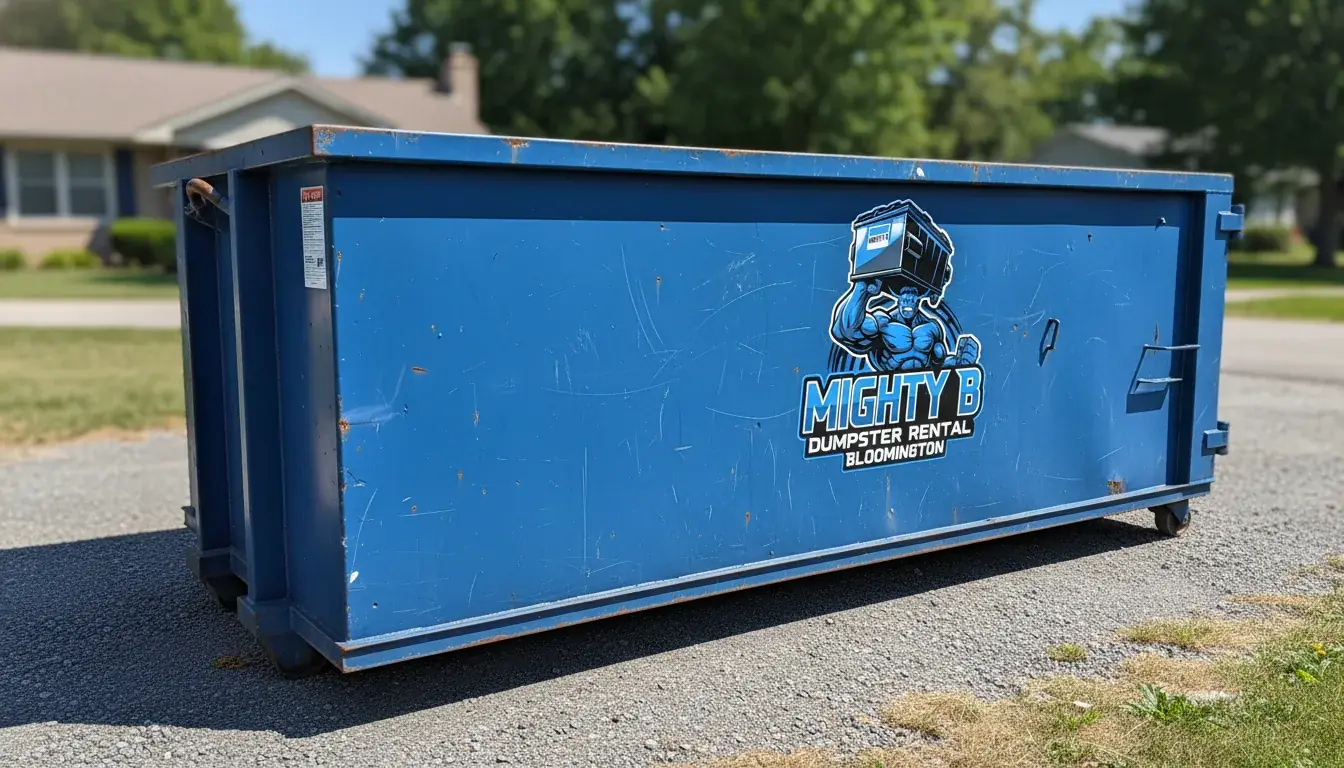
The driveway is almost always the right answer. It is your property, it needs no permit, and it keeps the container off the street where snow plows, mail carriers and your neighbors have to work around it. Before we set anything down, our driver lays timber boards under the rails and under the rear wheels so the load is spread across the slab instead of concentrated on four steel points.
What we need to know ahead of time:
- Overhead clearance. The box has to tip up to roughly the height of a two-story roofline as it comes off the truck. Low branches on the older west-side streets and service drops running to a detached garage are the two things that stop a delivery cold.
- Slope and surface. A steep drive is fine; we set the container with the door facing downhill so nothing swings at you. Gravel lanes out in the county are fine when they are dry, and a genuine problem in March.
- Which way the door faces. Tell us where you are carrying from. Walking an extra thirty feet with a mattress is the difference between a two-hour job and an all-afternoon one.
- Anything soft. A sprinkler head, a septic lid, a lawn you have babied all summer. We will keep the truck off it.
Street placement is a different situation and involves the city's right-of-way rules, so ask us first rather than assuming. More detail on surface protection is in our guide to protecting your driveway during a dumpster delivery.
What a Three-Bedroom Clear-Out Really Fills
Homeowners consistently guess low, then need a second haul. The reason is that household junk is deceptive: it is mostly air until you get to the furniture, and then it is mostly weight. Here is how the common Bloomington jobs land in practice.
| The job | Usual size | What tips it bigger |
|---|---|---|
| Single-car garage, shelving and boxes | 10 or 15 yard | Old workbench, tires, a chest freezer |
| Full basement, dry, no water damage | 20 yard | Sectional sofa, exercise equipment, carpet |
| Basement after flooding | 15 or 20 yard | Never go bigger - wet material is a weight problem, not a volume one |
| Attic plus garage plus a shed | 20 yard | Anything with a mattress in it |
| Whole three-bedroom house cleared | 30 yard | Appliances, bedroom sets, forty years of storage |
| Kitchen and one bath remodel | 15 or 20 yard | Cast-iron tub, tile, plaster instead of drywall |
The honest rule after thirteen years of this: if you are torn between two sizes on a household cleanout, take the larger one. The price gap between neighboring sizes is far smaller than the cost of a second delivery, and an empty foot of container costs nothing. The one exception is dense wet material, where a bigger box just invites you to overload it. Compare capacities side by side on our dumpster sizes page, or read the longer walkthrough in what size dumpster do I need.
The Wet-Basement Weight Trap
This one costs Bloomington homeowners more money than any other mistake, so it is worth being blunt about. Flat prairie ground and heavy clay soil mean water has nowhere to go. It sits against foundation walls, finds the crack it always finds, and ends up on a finished basement floor - most often during a March thaw or after a summer storm that dumps two inches in forty minutes.
Materials that come out of that basement are saturated. Wet carpet and pad hold an enormous amount of water. So do drywall, particleboard furniture, cardboard storage boxes and anything upholstered. A 20 yard container packed to the rails with dry garage clutter and the same container packed with soaked basement contents are not remotely the same load on a scale.
What actually helps:
- Let material drain and dry on the driveway or in the garage for a day before it goes in the box, if the weather allows it.
- Cut carpet into strips and roll it rather than folding it - it drains, and it packs flat instead of trapping air.
- Keep a tarp over the open container. Central Illinois rain and snow will add hundreds of pounds of pure water to a load that was already at its limit.
- Order the size the material needs, not the size the room looks like. A 15 yard box filled correctly beats a 30 yard box that cannot be lifted legally.
Tell us it is a water job when you call and we will size it around weight instead of volume. Our flooded basement cleanout guide covers the order of operations for the rest of it.
Loading Order, Tarps and Keeping the Neighbors Happy
Loading a residential container well takes maybe fifteen minutes of thought and saves you a size. Flat and heavy first: doors, plywood, headboards, sheets of paneling laid across the floor. Then the bulky furniture, broken down as far as you are willing to break it down - a dresser with the drawers out and the back panel snapped off takes a third of the space. Fill the voids with bagged small stuff. Save one light layer for the top.
Two hard limits. Nothing rides above the top rail, because the container has to be tarped for the drive and anything proud of the rails is a road hazard. And weight has to sit reasonably even front to back, or the box does not roll on cleanly.
On the neighbor side, a few things go a long way in a town where people know each other:
- Give the folks either side a heads-up on delivery day, especially on the tight older streets where an extra truck changes how everyone parks.
- Cover the container overnight. It keeps rain out, keeps the smell down in July, and it stops the quiet local tradition of other people's junk appearing in your box.
- Do the noisy demolition inside daylight hours. Dragging a metal shed frame across concrete at 7am does not make friends.
- Sweep the drive and the street edge when we pull the box. Screws and nail-studded trim end up in tires.
If you would rather not load anything yourself, our junk removal service handles the carrying too.
What Illinois Will Not Let You Put in the Box
Illinois restricts more household material than most people expect, and the restrictions are statewide law rather than something our company invented. Get these wrong and the load gets rejected at the gate, which turns into a delay and a charge nobody wanted.
Electronics
Televisions, monitors, computers, printers and peripherals are banned from Illinois landfills under the Electronic Products Recycling and Reuse Act. They have to be recycled separately. A basement cleanout in a State Farm household usually turns up two dead PCs and a tube TV, so plan for them from the start.
Yard and landscape waste
Grass, leaves, brush and branches have been banned from Illinois landfills since 1990 and go to composting instead. Keep them out of the mixed household load - we run a separate yard waste service for exactly this reason.
Appliances with refrigerant
Fridges, freezers, window air conditioners and dehumidifiers need professional refrigerant recovery before disposal. Tell us and we will explain how to handle it.
Liquids, paint and chemicals
No liquids, wet paint, solvents, used oil, propane tanks, lead-acid batteries or whole tires. Latex paint can go in only after it is fully dried out with hardener or kitty litter and the lid left off. Oil-based paint and solvents are household hazardous waste.
The Ecology Action Center in Normal is the local hub for recycling and hazardous waste questions in McLean County, and the Illinois EPA publishes the statewide rules.
Sizing
Which size for this job?
| Container | When it suits this job |
|---|---|
| 10 Yard | One room, a single-car garage, or a small bathroom gut. Also the right pick for anything dense - a 10 yard is the container we send when a homeowner is clearing out saturated basement material or old tile. |
| 15 Yard | The workhorse for a garage plus a shed, a modest kitchen remodel, or a first pass at a basement. Low walls make it easy to load over the side without a ramp. |
| 20 Yard | The most common residential order in Bloomington. Handles a full basement, a three-bedroom decluttering, or a kitchen and bath done together, and still sits comfortably on a standard driveway. |
| 30 Yard | Whole-house cleanouts, estate clearances and multi-room renovations. You need real driveway length for this one - measure before ordering on a tight older lot. |
| 40 Yard | Only correct for bulky, light volume: a house packed floor to ceiling with boxes, furniture and empty storage. It is the wrong container for anything dense. Wet basement material, plaster, tile or masonry will exceed the weight limit long before the box looks full. |
Still weighing it up? Read the full sizing guide, compare every container size, or just describe the job on the phone and we will pick for you.
Need residential dumpster rental in Bloomington?
One call gets you a size, a flat rate and a delivery slot. Usually under four minutes.
Answers
Residential Dumpster Rental — questions we get asked
Will the dumpster damage my driveway?
Not if it is set correctly. Every residential drop gets timber protection boards under the rails and the rear wheels, which spreads the load across the slab instead of concentrating it on steel corners. The larger risk in Bloomington is heat - asphalt softens badly on a humid July afternoon, so we schedule blacktop drives for morning deliveries. If your concrete is newer or already cracked, mention it when you book and we will place accordingly.
How long can I keep it?
Seven days is standard and covers most household projects comfortably. Extensions are easy - just call before your pickup date rather than after, so we can keep the container on your schedule instead of the truck's. Plenty of homeowners doing a weekend garage attack are done in two days and call us to pull it early, which is fine too. If you know upfront you need three weeks, tell us at booking.
Do I need a permit for a dumpster at my house?
Not for a container sitting on your own driveway, which is where the vast majority of our residential drops go. Permits come into play when the box has to sit on a public street or in the right-of-way, and those rules are set by the City of Bloomington or the Town of Normal depending on your address. Call us before you assume street placement and we will walk you through it.
Can I put a mattress and old furniture in?
Yes. Mattresses, box springs, sofas, recliners and bed frames all go in a residential container. Break down what you can - a dresser with drawers pulled and the back panel removed uses about a third of the space of an intact one. Mattresses are the single biggest space waster in a household load, so put them in flat and early rather than trying to wedge them in at the end.
What if I fill it before the week is up?
Call us and we will swap it. On a weekday, if you reach us before noon there is a good chance we can pull the full container and set an empty one the same day. It is common on whole-house cleanouts and estate jobs, and it is usually cheaper than ordering one enormous container you cannot fill efficiently. Call (309) 503-0748 and we will get the next box moving.
You might also need
Related services
Verified sources
Local & Official Resources
We are a private hauler, not a government agency. For rules, fees and hours, always go straight to the source:
- City of Bloomington — permits, right-of-way, refuse & recycling for Bloomington addresses
- Town of Normal — the Town of Normal runs its own separate programmes and permits
- McLean County — county services for unincorporated McLean County
- Ecology Action Center — McLean County recycling and household hazardous waste information hub
- Illinois EPA waste management — Illinois landfill bans and waste regulation
- JULIE / Illinois 811 — call 811 before any digging or footing work