
Roll-Off Dumpster Rental · Bloomington, IL
Roll-Off Dumpster Rental in Bloomington, IL
Open-top steel containers from 10 to 40 yards, delivered anywhere in McLean County and set on driveway protection boards. One flat number covers delivery, pickup, your weight allowance, disposal and Illinois tax.
- Same-day & next-day delivery
- Flat-rate, all-in pricing
- Driveway protection included
- Same-Day DeliveryCall before noon and we can usually be there today.
- Flat-Rate PricingDelivery, pickup, disposal and tax quoted up front.
- Licensed & InsuredFully insured and licensed to haul in Illinois.
- Locally Owned2013-founded, family run, based right here in Bloomington.
Overview
Roll-Off Dumpster Rental in Bloomington
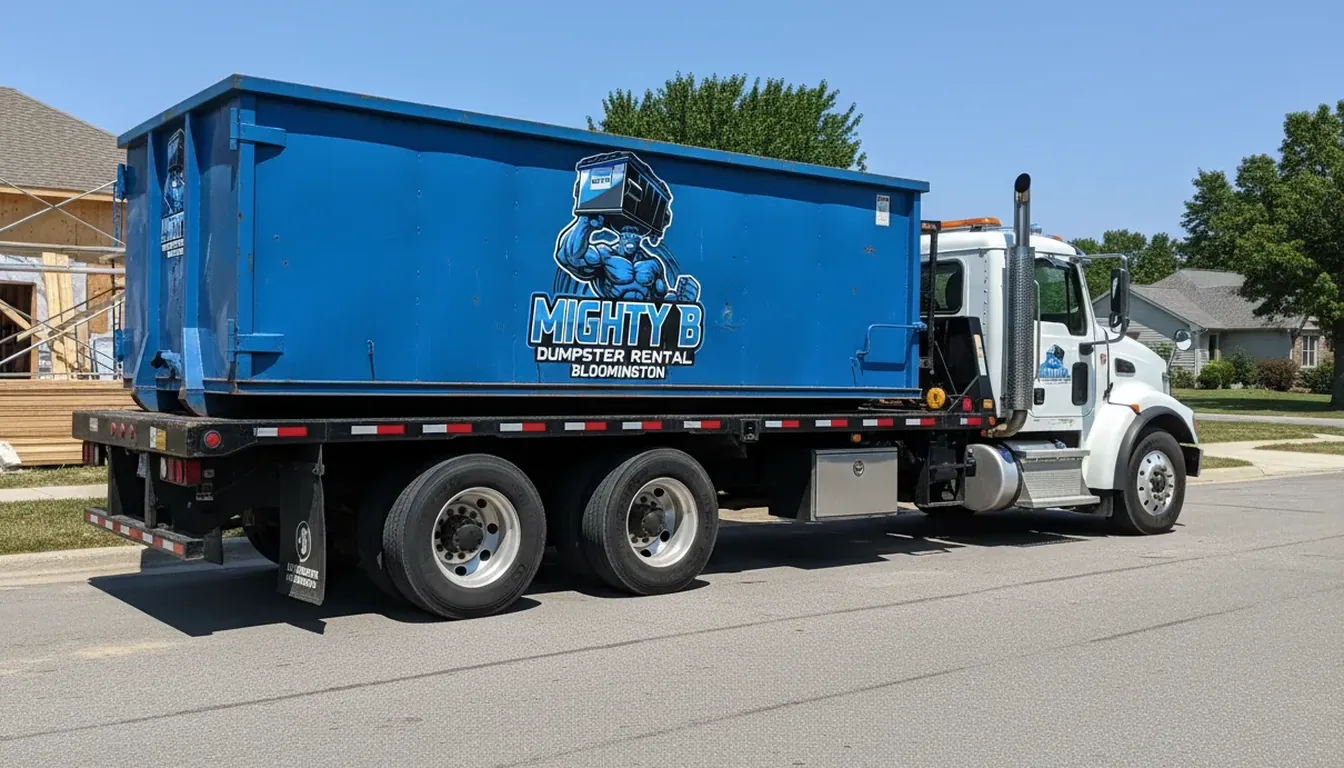
A roll-off is the open-top steel container you see sitting in driveways all over Bloomington — ten to forty cubic yards, open at the top, with a swing door on the back end so you can walk a wheelbarrow in instead of heaving every armload over the side. The name comes from how it arrives. The truck backs in, tips its rails up on an angle, and the box rolls off the back on its two rear wheels. Pickup day is the same motion in reverse, with a cable winching it back up the rails.
We have been running these boxes out of our yard on High St since 2013, and it is still a family operation, which means the person who answers the phone usually knows exactly where the truck is. That matters more than it sounds. Most of what makes a rental go smoothly gets settled before the truck ever leaves the lot — which way your drive runs, whether there is a low limb over the apron, whether you are pulling shingles or gutting a plaster-and-lath wall. Those last two look similar in a photo and weigh nothing alike.
Pricing is flat rate. One number covers delivery, the seven-day rental, pickup, your weight allowance, disposal and tax. No fuel surcharge invented at the end of the week, no mileage line because you happen to live out past Danvers. If a load runs over its weight allowance you pay the posted overage rate, and you hear that rate on the booking call instead of reading it on an invoice. What we quote is what shows up.
Most residential jobs in the Twin Cities land on a 15 or a 20. Roofs go smaller than people expect; basements and old-house gut jobs go bigger. If you are not sure, tell us the room or the project and roughly how much of it is leaving, and we will size it on the phone in about a minute. Our size comparison page lays all five boxes out side by side, and this walkthrough covers the judgment calls that photos never show.
Accepted materials
What goes in — and what doesn't
Good for
- Whole-house cleanouts and downsizing moves
- Kitchen, bathroom and basement remodels
- Single-family roof tear-offs
- Garage, shed and pole-barn clear-outs
- Storm debris after straight-line wind or hail
- Deck, fence and small structure demolition
- Rental turnovers between tenants
- Office and small commercial clear-outs
Cannot go in
- TVs, monitors, computers and printers - banned from Illinois landfills, must go to an electronics recycling collection
- Grass, leaves, brush and branches - banned since 1990, must go to a landscape waste composting program
- Refrigerators, freezers and window AC units - refrigerant must be professionally recovered first, then the shell can go
- Whole tires - must go back to a tire retailer or a county collection event
- Lead-acid car, truck and tractor batteries - must go to an auto parts store or scrap yard take-back
- Wet paint, solvents, used oil and propane tanks - must go to a household hazardous waste collection
Illinois bans a specific list of materials from landfills — electronics, landscape waste, tires, lead-acid batteries, used oil and refrigerant appliances. If you are unsure about an item, call (309) 503-0748 before it goes in the container — it costs nothing to ask and a lot to sort out afterwards. Full detail in our banned materials guide.
How a Roll-Off Truck Actually Sets the Box
Two very different trucks get called dumpster trucks and they are not the same machine. The one that empties the steel bin behind a restaurant is a front-loader — it picks the container straight up and tips it over the cab. A roll-off truck never lifts anything over your house. It carries the container on a pair of steel rails, and a hydraulic hoist raises those rails while a cable pays the box down the back until the rear wheels touch pavement and it rolls clear. On pickup the cable does the pulling and the rails do the rest.
That mechanism explains almost every question we get about placement. The driver needs a straight line in and out, not a parking space. The box lands where the truck can line up with it, so we would rather walk the drive with you for thirty seconds than guess. And because everything happens on an angle, height matters as much as width.
Two things worth telling the driver before he sets it:
- Which way you want the swing door facing. Once there is a couch in the box, nobody is turning it. If you are wheeling debris out of a detached garage, point the door at the garage.
- Where the soft spots are. New concrete, a resealed asphalt apron, a septic lid, a buried downspout line. We would rather set the box two feet over than guess wrong.
Every residential drop goes down on driveway protection boards, no exceptions and no upcharge. If you want to know exactly what that protects against, we broke it down in our driveway protection guide.
Five Sizes, and What Each One Is Really For
All five boxes are the same idea, but they are not just the same shape scaled up. As the yardage climbs, the length grows first and then the walls get taller. That changes how you load far more than the cubic-yard number suggests.
A 10 yard is short with low sides — easy to pitch things into, and the one we send for concrete, brick, dirt and roofing tear-off, because those loads hit their weight limit long before they fill the box. A 15 yard is the quiet workhorse for a single-room remodel or a serious garage purge. The 20 yard is our most-booked container and the safe default for a kitchen gut, a bathroom plus a basement, or a whole-house declutter; see the 20 yard page for footprint and clearance numbers.
A 30 yard is where whole-house cleanouts, siding jobs and additions live. The 40 yard is bulk volume — commercial clear-outs, farm outbuildings, big light debris like insulation, cabinetry and ductwork. Its walls run about eight feet, which is wonderful for capacity and unkind to anyone trying to lift a recliner over the side. On a 40 you load through the swing door and stack, or you rent the smaller box and accept a swap.
Two rules that override the size chart every time: heavy dense material goes in a small container, and a box you can only fill three quarters of the way because you cannot reach the top is not the right box. Tell us the material, not just the volume. Plaster and lath from a pre-1940 house on the west side weighs two to three times what the same wall in a 1990s Hershey Road subdivision weighs, and that single fact has moved more of our size recommendations than anything else.
Access: About 60 Feet of Approach, About 23 Feet Overhead
Here are the working numbers. A roll-off truck wants roughly 60 feet of straight approach — that is the truck plus the container as the box rolls off behind it — and about 23 feet of vertical clearance, because the rails go way up before anything comes down. You also want something like 10 to 12 feet of width to swing the door and walk beside the box.
How that plays out depends entirely on which Bloomington you live in. West and south of downtown the housing stock is pre-1940: narrow single-lane drives, detached garages sitting at the back of the lot off an alley, and mature silver maples with limbs hanging over the apron. Overhead service drops to the house are the other common stopper. None of that is fatal — we set boxes on those streets constantly — but it usually means a 10, 15 or 20 rather than a 30, and it means we want to hear about the tree before delivery day, not while the driver is sitting out front.
East side is the easy version. The Hershey Road and Veterans Parkway subdivisions from the nineties on have wide aprons, deep drives and clear sky. In the surrounding farm towns the constraint is different again: gravel lanes and soft shoulders, which are fine on frozen winter ground and treacherous during the March and April thaw. One more seasonal note — asphalt softens on a humid July afternoon, so we book those drops in the morning.
If the only workable spot is the street rather than the drive, that is a city question before it is our question. Start with the City of Bloomington and read our permit rundown first.
Load It Level With the Top Rail, Every Time
This is the one rule we will not bend on, so it is worth explaining rather than just stating. Once a container leaves your driveway it is a load on a public road. It has to be coverable, and the axle weights have to be legal on I-55, I-74 and the two-lanes out to the villages. A box heaped above the rails cannot be tarped, and anything that blows out of it at highway speed is a genuine hazard to the car behind us. So a driver who arrives to find debris stacked over the rail has two choices: wait while you pull it down, or leave without it. Neither one is a good morning for anybody.
Level with the top rail. Nothing sticking up, nothing hanging over the side, no mattress laid across the top like a lid.
A few habits that keep you under the line:
- Heavy and flat on the floor first. Plaster, shingles, tile and concrete belong on the bottom, spread out, not piled in one corner.
- Break down what you can. A pulled-apart bookshelf takes a third of the room the assembled one does. Snap the legs off the table.
- Fill the voids. Bags of scrap go inside the dresser and under the couch, not on top of it.
- Watch the weather. Rain and snow soak into drywall, carpet and cardboard and add real tonnage to an open box. If a storm is coming and you are close to full, call for pickup rather than letting it drink for three days.
Doing it this way is also how you avoid an overage. Volume you control by stacking; weight you control by what you put in and how long it sits open.
What the Flat Rate Covers, and What Honestly Costs Extra
Flat rate means the quote you get on the phone is the whole number for a normal rental — not a base price with five categories of add-on waiting behind it. Here is the honest split, because pretending nothing ever costs extra would be its own kind of lie.
| In your quoted flat rate | Charged separately (and quoted up front) |
|---|---|
| Delivery to your address | Weight over your included allowance, at the posted per-ton rate |
| Seven days of rental | Extra days past seven, at a daily rate |
| Pickup and hauling | A swap-out when you fill it and need a second load |
| Your weight allowance and disposal | Banned items we have to pull back out at the scale |
| Illinois tax | A dry run when the box is blocked in on pickup day |
| Driveway protection boards |
The two that actually bite people are weight and access. Weight sneaks up when a load turns out to be denser than expected — old plaster, wet carpet from a spring basement flood, a load of shingles with two layers under them. Access is easier to avoid: park the cars somewhere else on pickup morning and do not stack anything against the box.
The banned-material line is not a penalty we enjoy charging. Electronics, tires, batteries, refrigerant appliances and liquids get pulled and handled separately because Illinois says so, and a scale operator finding a TV in the middle of a load costs everybody time. Ask us first — it is a thirty-second conversation. Full detail lives on our pricing page, and the Illinois EPA publishes the statewide rules. When you are ready, get in touch or call (309) 503-0748.
Sizing
Which size for this job?
| Container | When it suits this job |
|---|---|
| 10 Yard | The heavy-material box. Concrete, brick, dirt, tile and roofing tear-off hit their weight limit long before they fill it. Also right for one small bathroom or a first pass at a packed garage. |
| 15 Yard | A single-room remodel, a serious garage or basement purge, or a small deck removal. Low enough walls that one person can still pitch debris in over the side. |
| 20 Yard | Our most-booked container and the safe default for a kitchen gut, a whole-house declutter, or a two-room remodel with cabinets and flooring. |
| 30 Yard | Whole-house cleanouts, siding jobs, additions and large storm debris. The size most families land on once they open the basement and count honestly. |
| 40 Yard | Bulk light volume - commercial clear-outs, farm outbuildings, insulation, cabinetry and ductwork. Eight-foot walls, so plan on loading through the swing door. |
Still weighing it up? Read the full sizing guide, compare every container size, or just describe the job on the phone and we will pick for you.
Need roll-off dumpster rental in Bloomington?
One call gets you a size, a flat rate and a delivery slot. Usually under four minutes.
Answers
Roll-Off Dumpster Rental — questions we get asked
How much room does the truck actually need?
Figure about 60 feet of straight approach and roughly 23 feet of overhead clearance. Width-wise you want 10 to 12 feet so the door can swing and you can walk alongside. Low tree limbs and overhead service lines to the house stop more deliveries in older west-side neighborhoods than tight driveways do. Tell us about anything hanging over the apron when you book and we will pick a box that fits the space.
Will the container wreck my driveway?
Every residential drop goes down on driveway protection boards at no charge, and that handles the normal case. The real risks are heat and weight: asphalt softens on humid July afternoons, so we schedule those deliveries in the morning, and a container loaded with concrete or plaster sits far heavier than one full of furniture. If your drive is new concrete or freshly sealed, say so and we will talk through placement.
What happens if I fill it above the top rail?
We cannot legally haul it. The load has to be coverable and the axle weights have to be legal on the highway, and an overfilled box is neither. Our driver will either wait while you pull material back down to the rail or come back another day, which costs you time. Level with the rail is the rule. Break down bulky items and fill the gaps and you will fit more than you expect anyway.
Can I keep it longer than seven days?
Yes. Seven days is the standard rental, and extending is a phone call at a daily rate. Just tell us before the scheduled pickup so the driver is not sent out for nothing. On bigger projects people often book the extra time up front, which is easier than scrambling mid-week. If you fill the box before you finish, we will swap it for an empty one instead.
Do you deliver outside Bloomington-Normal?
We run all over McLean County and the surrounding farm towns, and there is no separate mileage charge tacked on for it - the flat rate is the flat rate. Gravel lanes and soft shoulders are the only real variable out there, and they are much better on frozen winter ground than during the spring thaw. Give us the address and any gate or lane details when you call.
You might also need
Related services
Verified sources
Local & Official Resources
We are a private hauler, not a government agency. For rules, fees and hours, always go straight to the source:
- City of Bloomington — permits, right-of-way, refuse & recycling for Bloomington addresses
- Town of Normal — the Town of Normal runs its own separate programmes and permits
- McLean County — county services for unincorporated McLean County
- Ecology Action Center — McLean County recycling and household hazardous waste information hub
- Illinois EPA waste management — Illinois landfill bans and waste regulation
- JULIE / Illinois 811 — call 811 before any digging or footing work