
Rules & Disposal
Bloomington Recycling & Disposal Guide: Where Junk Goes
Curbside carts, transfer stations, tipping fees and Illinois landfill bans explained plainly, plus a quick-reference table of where every awkward item in your house actually ends up.
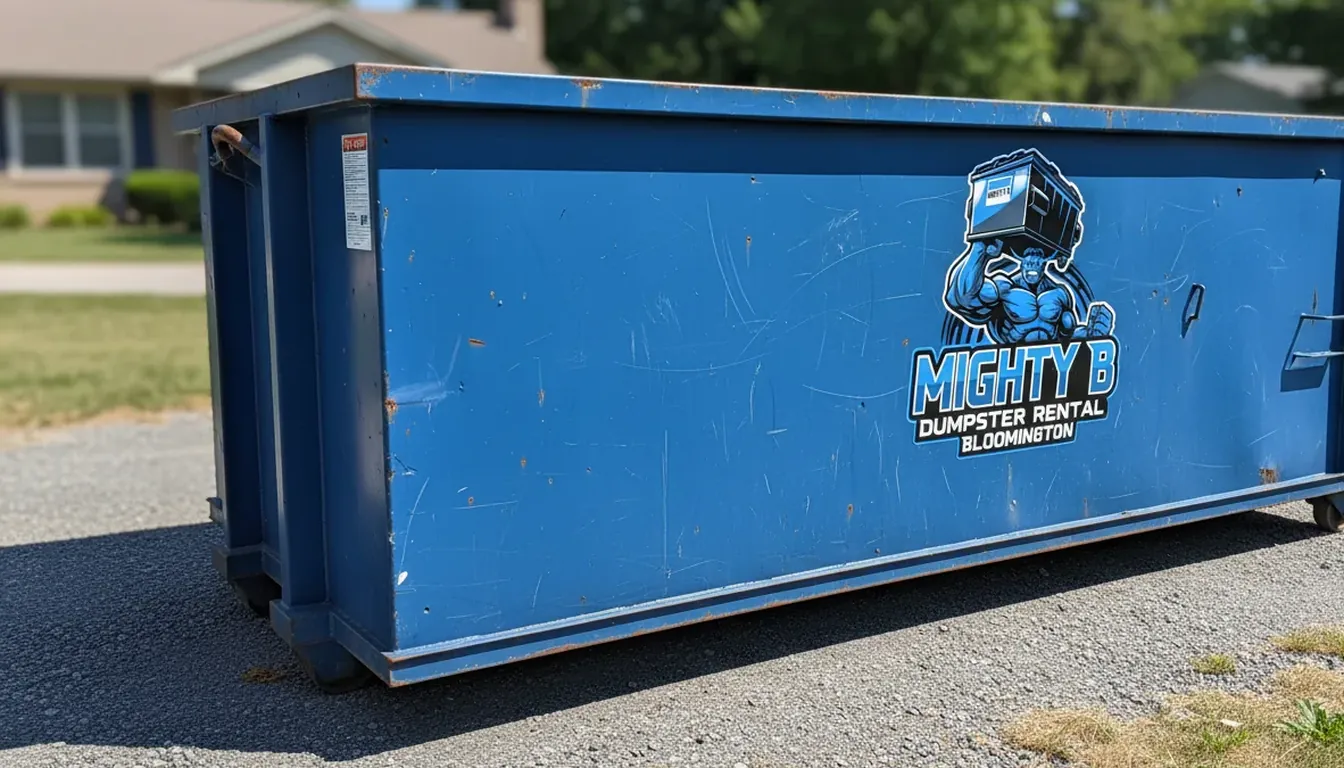
People ask us where it goes. Not on the phone — there they ask about size and price — but standing in the driveway watching a box get hooked up, somebody usually says it: "so where does all that actually end up?" It depends entirely on what you put in it. A load of clean framing lumber and a load of mixed household junk leave the same driveway on the same truck and end up in completely different places. Here is the plain version for Bloomington and Normal.
Your curbside cart and a roll-off are two different systems
Municipal collection and roll-off service are not competitors, and Bloomington and Normal each run their own residential programme. Shared newspaper, shared airport — but two municipalities with two sets of rules: different carts, calendars, bulky-item policies and recycling instructions. What your cousin on the Normal side of Division Street does with a mattress is not necessarily what you do three blocks south. The City of Bloomington and the Town of Normal both publish current collection details, and those change often enough that quoting them here would do you a disservice.
What is consistent is the shape of the limits. Curbside is built around a fixed-volume cart on a repeating schedule — excellent for the trickle a household produces, useless once it stops being a trickle:
- Volume caps. A cart holds what a cart holds. Overfilled lids, bags alongside and anything the automated arm cannot grab do not get taken.
- Bulky items are a separate transaction. Couches, mattresses, appliances and carpet rolls fall under special-pickup or sticker programmes with limits on how many and how often. One couch, fine. A houseful, no.
- Construction debris is usually excluded. Tear-out from a bathroom remodel — plaster, lath, tile, tub, subfloor — is not household waste, and most programmes say so.
- Weight. Automated arms have a lifting limit, which matters west and south of downtown where pre-1940 plaster-and-lath runs two to three times the weight of drywall.
Ongoing household waste is a curbside job. A project with a start and an end date — remodel, roof, garage, estate, flooded basement, student move-out — is a roll-off job. Even a 10 yard container swallows a dozen weeks of cart service in one afternoon.
Transfer stations, landfills and the fee behind your flat rate
Most loads do not drive straight to a landfill. Central Illinois runs on transfer stations: enclosed facilities where trucks tip onto a floor, material is consolidated, recoverable and prohibited items get pulled off, and the rest is reloaded into long-haul trailers. One trailer replaces several roll-off trips, and it is where a lot of contamination gets caught, because there are eyes on the tipping floor.
A permitted landfill is not a hole in the ground. It is an engineered, licensed containment structure — a lined cell with leachate collection piping beneath it, daily cover, perimeter groundwater monitoring wells, gas collection and a binding post-closure care obligation that outlives the site's operating life. Accepted materials and capping are written into that state permit. Recycling and composting facilities run under separate permits and accepted-material lists.
The tipping fee is what a facility charges to accept material, almost always billed by the ton across a scale, and it is the biggest moving part in your rental. When we quote one flat rate covering delivery, pickup, weight allowance, disposal and tax, we are absorbing that per-ton cost and betting on the weight of your load. It is why shingles and cardboard cost differently to handle despite filling the same space, and it is the whole reason a weight allowance exists. Our pricing page walks through the maths.
Start with the Ecology Action Center
If you take one practical thing from this article, take this: the Ecology Action Center in Normal is McLean County's recycling and household-hazardous-waste information hub, and it should be your first stop for anything you are unsure about. They are the local clearing house for what is accepted where, which collection events are scheduled, how the electronics programme is running, and what to do with genuinely awkward items. Drop-off sites fill up and recyclers change accepted lists — their current information beats a two-year-old blog post, this one included.
What Illinois will not put in the ground
Illinois bans specific materials from landfill disposal statewide. Not house rules, not negotiable at the scale — state law, enforced by facilities because their permits depend on it.
Electronics. Under the Electronic Products Recycling and Reuse Act, covered electronics are banned from Illinois landfills: televisions, monitors, computers, printers and peripherals. They hold lead and mercury nobody wants in a landfill cell, plus copper, aluminium and gold somebody does, and must go through an electronics recycling channel.
Landscape waste. Banned since 1990. Grass, leaves, brush and the limbs a June derecho drops across your back yard are composting and mulching material running through a separate permitted stream, which is why we handle them in a dedicated yard waste container. Storm work is the classic trap: limbs thrown on fence panels and shingles make a mixed load that is expensive to sort.
Whole tires. Banned. They float up through a landfill cell, trap methane and breed mosquitoes, so they go to a recycler for shredding into crumb rubber or fuel. Farm properties around Danvers, Colfax and Saybrook turn up stacks in fence rows.
Lead-acid batteries. Banned, and a genuine recycling success story — lead, case and acid all recovered. Any retailer selling car and tractor batteries takes the old one.
Used oil and filters. Banned, and worth taking seriously — used motor oil is a contaminant at very small volumes. Filters hold a surprising amount of residual oil and need draining and recycling.
Appliances containing refrigerant. Refrigerators, freezers, window air conditioners and dehumidifiers cannot be landfilled or scrapped until a certified technician recovers the refrigerant. Venting it is illegal. Once recovery is documented, the shell is scrap.
Also restricted: free liquids, wet paint, solvents, pesticides, pressurised cylinders, and asbestos-containing material, which has its own abatement rules. Our full allowed-and-banned list goes item by item.
"Recyclable C&D" — and why sorting saves you money
Construction and demolition debris is not one material. Mixed, it is a disposal problem. Separated, several parts of it have a market. The four that matter on a Twin Cities job:
- Clean wood. Untreated, unpainted lumber, plywood, pallets and crating, ground into mulch, bedding or biomass fuel. "Clean" is doing real work there — treated, painted or laminated wood contaminates the pile.
- Clean concrete, brick and block. Crushed into recycled aggregate for road base and fill. Clean means no wood, rebar tangles, plastic, dirt or trash mixed in. We run these in a dedicated small heavy debris container, because material this dense fills the weight allowance long before the box.
- Scrap metal. Steel studs, ductwork, pipe, radiators, guttering, appliance shells, rebar, aluminium siding, copper — a century-old market that never went away.
- Cardboard. The one everybody underestimates. A remodel produces enormous volumes. Flat and dry it is recyclable; soaked through a spring rain in an open container, it is waste.
A single-material load goes to a facility that wants it, at a rate reflecting its value. A mixed load has to be sorted by somebody, and that labour appears on your invoice. Gutting a kitchen? A corner of the garage for metal and a flat stack of cardboard costs nothing.
Paint, appliances, medications and the rest
Latex paint is the most common garage-shelf problem here. Liquid paint is a free liquid and cannot go in a container; dried latex is an inert solid and can. Lid off, stir in cat litter, sawdust or hardener, leave it ventilated until solid through — not just skinned over — and send it in lid-off so it can be checked at a glance. A half-inch dries in a day or two; a gallon needs shallow trays or a week.
Oil-based paint, stain, varnish, thinner and solvents never dry into anything acceptable. Those are household hazardous waste, along with pesticides, pool chemicals, automotive fluids and mercury thermometers. HHW moves through collection events and designated facilities, not a permanent counter — another reason the Ecology Action Center is the right first call.
Appliances and scrap metal. Non-refrigerant appliances — washers, dryers, ranges, dishwashers, water heaters, furnaces — can go in a container, but they are dense steel and a scrap dealer will usually take them for free or better. On a whole-house cleanout, pulling metal first visibly changes the load weight.
Medications and sharps. Medications never go in a dumpster, down the toilet or down the sink — treatment plants are not designed to remove pharmaceutical compounds and they pass through into surface water. Use a drug take-back box; most police departments and many pharmacies host one. Needles, lancets and syringes go in a rigid, sealed sharps container through a proper channel, never loose in a bag. Loose needles injure the people sorting your load.
Textiles and furniture. Be realistic. Charities want clean, dry, saleable goods and are entitled to. A sofa with a torn cushion, a stained mattress, a scratched particle-board dresser, a box of damp basement clothes — those are not donations, they are a disposal cost handed to a non-profit, and they will decline them. Call ahead on the genuinely good items; clothing too worn to wear can often still go to fabric recycling. Everything else belongs in the box — our estate cleanout checklist works through sorting a house.
Quick reference: where it actually goes
| Item | Where it actually goes | Notes |
|---|---|---|
| Household junk, furniture, carpet | Roll-off, transfer station, landfill | Donate saleable items |
| Remodel and demolition debris | Roll-off, transfer station | Not accepted curbside |
| Weekly kitchen and bathroom waste | Municipal curbside cart | Separate city programmes |
| One couch or mattress | Curbside bulky-item or special pickup | Item limits apply |
| TVs, monitors, computers, printers | Electronics recycling | Banned under the Electronic Products Act |
| Grass, leaves, brush, branches | Composting or mulching facility | Landfill-banned since 1990 |
| Whole tires | Tire recycler | Shredded for rubber or fuel |
| Car and tractor batteries | Retailer take-back | Fully recovered |
| Used motor oil and filters | Oil recycling point | Drain filters, never bag |
| Fridge, freezer, window A/C, dehumidifier | Recovery, then scrap | Venting is illegal |
| Washer, dryer, range, water heater | Scrap dealer, or the container | Scrap often pays |
| Clean untreated wood | Mulch or biomass | Paint or treatment disqualifies |
| Clean concrete, brick, block | Crusher, recycled aggregate | Own container, no mixing |
| Scrap metal | Scrap yard | Pull out before load day |
| Cardboard | Paper recycling | Flatten, keep dry |
| Latex paint | Container, fully hardened | Litter or hardener, lid off |
| Oil-based paint, stain, solvent | Household hazardous waste | Never dries acceptable |
| Pesticides, pool and auto chemicals | Household hazardous waste | Collection events |
| Propane and pressurised cylinders | Exchange programme or HHW | Explosion hazard |
| Medications | Drug take-back box | Not toilet or sink |
| Needles, lancets, syringes | Sealed sharps container | Never loose, ever |
| Wearable clothing, usable furniture | Donation, call ahead | Saleable only |
| Asbestos-containing material | Licensed abatement contractor | Never DIY |
Why this matters more here than most places
Central Illinois is a bad place to be careless with waste, and the reason is under your feet. McLean County sits on some of the most productive farmland on earth, and that productivity is engineered. Heavy prairie clay does not drain on its own, so the ground out to the county line is laced with subsurface drainage tile — perforated pipe buried a few feet down, running to ditches and creeks, then to the Mackinaw and the Sangamon. It is what makes row-crop farming work here. It also means a liquid poured on a field, in a fence row or down a gravel lane does not slowly filter through soil the way people imagine. It finds a tile line, then open water, fast.
Layer on shallow aquifers and rural households on private wells and the maths gets uncomfortable. A single gallon of used motor oil is a serious contamination event at drinking-water scale. Solvent poured behind a machine shed near Ellsworth or Bellflower is not gone, it is moving — and ground frozen in February and waterlogged in April moves water sideways.
Illegal dumping is a real problem on the rural blacktops too. Tires, shingles or paint cans in a timber lot or road ditch are not somebody else's mess for long — the landowner pays to remove them and the pile leaches into a watershed the whole time it sits. That is the practical reason we are strict about what goes in the box: the alternative is not free, it is billed to somebody else later. Keep the banned items out, separate what has a market, point the awkward stuff at the programme built for it, and let the rest go through a permitted, monitored system built for exactly this.
Not sure where something belongs? Call Mighty B Dumpster Rental Bloomington at (309) 503-0748 and describe it — we will tell you straight whether it goes in the box, to scrap, to a recycler or to household hazardous waste, and we would rather sort that out before delivery than at the scale. Flat-rate pricing, 10 to 40 yard containers, driveway boards every time, same-day delivery across Bloomington, Normal and McLean County if you call before noon on a weekday.
Need a container in Bloomington or anywhere in McLean County? Call (309) 503-0748 and describe the job. We will name the size, the flat rate and a delivery slot — often the same day. No forms, no waiting on an email.