
Permits & Placement
Dumpster Permits in Bloomington & Normal IL: The Rules
Driveway placement almost never needs a permit; the street, alley or parkway usually does. Bloomington and Normal have separate rules, and so does every village around them.
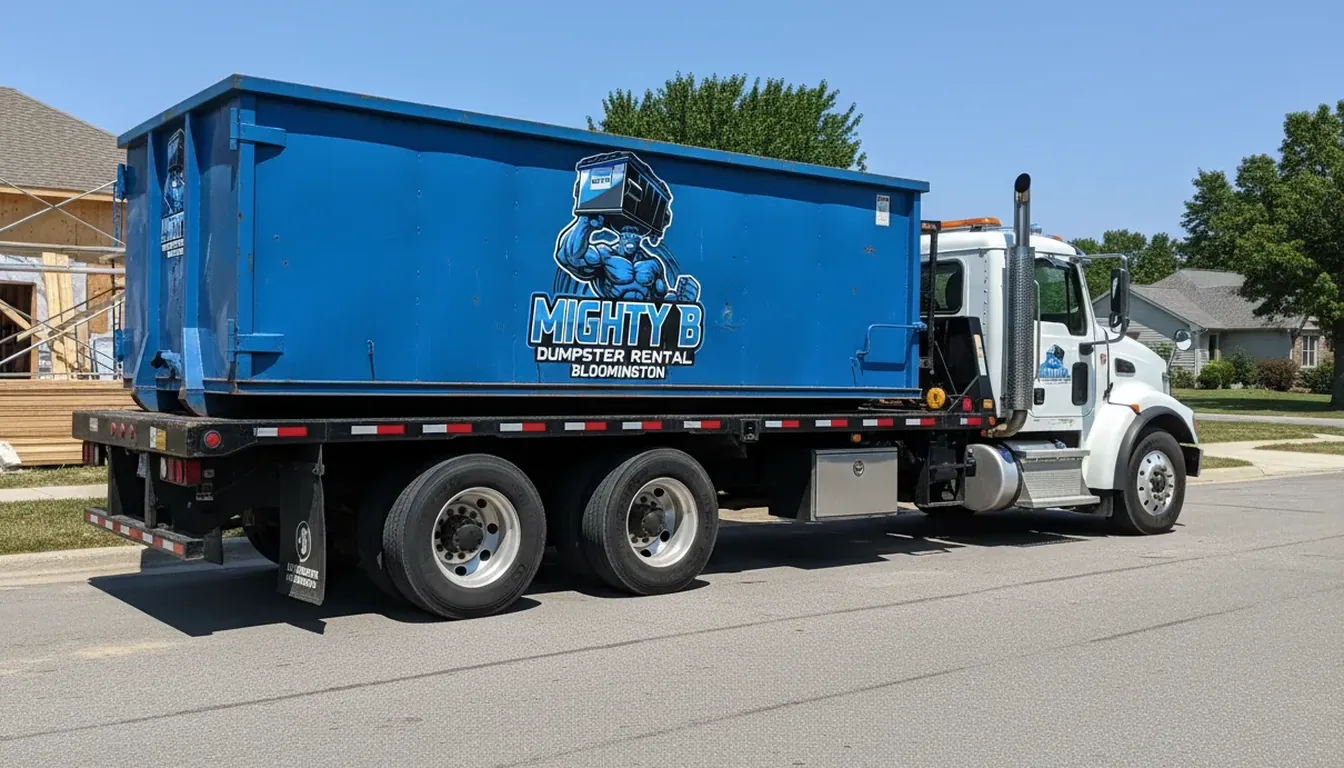
The short answer, for most of the people who call us about this: no, you probably do not need one. If the container is going to sit entirely on your own driveway, your own yard or your own job site, neither Bloomington nor Normal is going to ask you for a permit to put it there. The moment any part of that box touches public property — the street, the parkway strip between the sidewalk and the curb, an alley, a sidewalk — you are in permit territory, and which office you deal with depends entirely on which side of a city line your address happens to fall on.
That is the whole thing in two sentences. The rest of this page is the detail that keeps people out of trouble, because permits are the one item customers reliably discover too late — usually with a container already sitting where it should not be.
Private property versus public right-of-way
Illinois municipalities all draw the same basic line. Private property is yours to use. The public right-of-way is not, even when it looks like part of your yard and even when you mow it.
That last point catches people out constantly. In most Bloomington and Normal neighborhoods the right-of-way does not stop at the curb. It typically runs from the curb across the terrace or parkway — the grass strip with the street trees and the fire hydrant in it — over the public sidewalk, and often a short distance behind it. Your deed may technically run to the centerline of the street; the city still holds an easement over the whole strip. You maintain it, you shovel it, you rake the leaves off it, and you still cannot park a ten-ton steel box on it without asking first.
So walk out front and work out where your usable private surface actually ends. On older lots west and south of downtown Bloomington the driveway is narrow and short and the sidewalk sits close to the house — exactly the situation where a 30 yard container ends up with its tail over public concrete. On the newer east-side subdivisions off Hershey Road and the Veterans Parkway corridor, driveways are wide and deep and the question rarely comes up.
Bloomington and Normal are two different cities
This is the single most important thing on this page. Bloomington and Normal are separate municipalities with separate codes, separate departments and separate paperwork. They share a school district boundary in places, a bus system, an airport and a general sense of being one town, and none of that means the rules are the same.
Start with the official source for the address in question: the City of Bloomington or the Town of Normal. If the property is in one of the surrounding villages — Hudson, Towanda, Downs, Heyworth, Le Roy, Danvers, Carlock, Lexington, Chenoa — that village has its own ordinance and its own village hall, and small towns are not automatically more relaxed about it. Out in unincorporated McLean County there is usually no municipal permit at all for a private lane or farmyard, but if you are anywhere near a county highway right-of-way the county highway department has an interest. And any placement on a state route, which around here means stretches of Veterans Parkway, Business 51 and the old Route 66 alignments, can bring the Illinois Department of Transportation into it.
Never assume the answer from one job carries to the next. We have had customers rent twice in a year — once at a house in Normal, once at a rental in Bloomington — and be genuinely surprised the process was not identical. Different city, different rules. Our service area page lists every town we run to, and each one is its own jurisdiction.
What a right-of-way or obstruction permit usually involves
If you do need one, it is paperwork, not a fight. Municipalities issue these routinely. In general terms, expect the process to include most of the following:
- An application submitted ahead of time. Not the morning of delivery. Build in lead time, and confirm the permit is approved before you confirm a drop date with us.
- A defined duration. Right-of-way permits are issued for a set window, and extensions are usually a separate request rather than something you can quietly let run.
- Reflectors, barricades or lighting overnight. An unlit steel container at the curb is a hazard, and marking it is normally the permit holder's responsibility.
- Proof of insurance. Typically a certificate of insurance from the hauler, sometimes naming the municipality.
- A fee. Amounts vary by jurisdiction and change over time, so ask the city directly rather than trusting anything you read online, including this page.
- Conditions on placement. Clearances from hydrants, intersections, crosswalks, driveways and bus stops are common, and downtown or campus-adjacent blocks often carry extra restrictions.
Placement scenarios, side by side
| Placement scenario | Permit likely needed? | Who to ask |
|---|---|---|
| Fully on your own driveway | No | Nobody — but check your HOA |
| On your own lawn, gravel pad or farmyard | No | Property owner; HOA if applicable |
| Driveway, but the tail overhangs the public sidewalk | Usually yes | Bloomington or Normal, whichever governs the address |
| On the terrace or parkway grass strip | Yes | The municipality — this is public land |
| At the curb on a residential street | Yes | The municipality |
| In the alley behind the house | Yes, plus access conditions | The municipality |
| Downtown Bloomington on-street | Yes, expect extra conditions | City of Bloomington |
| Parking lot of an apartment or retail property you do not own | No city permit, but written owner consent | Landlord or property manager |
| Active construction site on private land | Often covered by the building permit | Your general contractor, then the city |
| Village street outside Bloomington-Normal | Yes, and rules differ by village | That village hall |
| Private lane in unincorporated McLean County | Generally no | County; highway department if near a county road |
Who pulls the permit, and what we supply
In almost every case the permit is pulled by the property owner or the contractor performing the work, not by the hauler. That surprises people who assume the rental includes the paperwork. It does not, and it generally cannot — the applicant usually has to be the party with an interest in the property or the job.
What a hauler provides is the supporting material: a certificate of insurance, container dimensions for the size you have booked, and firm delivery and pickup dates so the permit window actually matches reality. Ask for all three at the point of booking rather than mid-application. If you tell us up front that the box is going on the street, we will have the paperwork ready and we will not schedule the drop until you confirm the permit is in hand. Container footprints for every size we run are on our sizes page, and those numbers are what the application wants.
December through March: keep it off the street
Even where a street placement is permitted, winter in Central Illinois is the wrong time for it. Municipal snow routes are planned around clear pavement, and a container parked at the curb turns into a plow obstruction the first time three inches falls overnight. Snow emergency parking rules can kick in with very little notice, and a dumpster is not a car you can move in five minutes.
The consequences are real: plows pack snow around the box, the container freezes to the pavement, and the driver cannot hook it on pickup day. Snow and rain also load an open container with dead weight that counts against your allowance the same as debris does. From December into March, plan on driveway placement and keep a tarp handy. Where the driveway is too tight, a smaller container set lengthwise usually beats a permit application in January.
HOAs, covenants and historic districts
City permission is not the only permission that matters. In the newer east-side subdivisions, homeowner association covenants frequently address temporary containers directly — how long one may stay, where it may sit, sometimes whether the board needs notice first. An HOA cannot issue a city permit, but it can absolutely make you move a container the city was perfectly happy with. Read the covenants before you book, not after the neighbor complains.
Older Bloomington neighborhoods bring a different consideration. Properties in or near historic districts can face additional review for exterior work, and while the dumpster is temporary, the project it serves may not be. If you are tearing off a roof, replacing windows or removing siding on a pre-1940 home, sort the work approvals out first — the container is the easy part. Narrow streets and mature trees in these blocks also mean the truck needs real overhead clearance, so mention low branches when you book.
Commercial and job-site placement
On commercial property the questions shift. If you lease rather than own, you need the owner or property manager's written consent before delivery, and you need to know which parking stalls you may give up. Fire lanes, accessible spaces and loading zones are off limits regardless of what the landlord says. Our commercial dumpster rental and construction dumpster rental pages cover scheduled swaps on live sites.
On an active construction job, placement is often already addressed by the building permit and the approved site plan. Confirm that rather than assume it — a site plan that puts the box inside the property line does not help if the crew keeps dragging it onto the parkway because that is easier for the excavator.
What happens if you skip it
Three things, in escalating order. First, a citation — an unpermitted obstruction in the right-of-way is a code violation, and tickets can be written per day. Second, forced removal on the city's schedule rather than yours, which usually lands mid-project with a half-full container.
Third, and by far the most serious: liability. If someone walks into an unlit container at the curb at night, or a driver clips it, whoever put it there without authorization is in a very poor position. A permit is not just permission; it is documentation that the placement was reviewed and marked as required. That is worth more than the fee.
Placement that avoids the question entirely
The cleanest solution to the permit question is to make it irrelevant. On most residential jobs in Bloomington-Normal, a well-planned driveway drop does exactly that.
Position for the whole rental, not just the drop
Back the container in so the doors open toward your work area, and leave room to walk a wheelbarrow past it. Roll-offs are delivered and retrieved on a straight pull, so the truck needs a clear approach with nothing overhead — branches, utility drops, basketball hoops. Keep the whole footprint, tail included, behind the sidewalk line, and measure before delivery day.
Protect the driveway and the apron
Concentrated steel loads mark concrete and asphalt, and the apron where the driveway meets the street takes the worst of it because the truck pivots there. We put driveway protection boards under every residential drop as standard. In July, when asphalt goes soft on a humid afternoon, take the morning delivery slot — there is more on that in our guide to protecting your driveway during a dumpster delivery. During spring thaw, keep containers off saturated lawns entirely; this clay soil does not recover quickly.
Stay clear of easements, and call 811 first
Utility easements often run along rear and side lot lines, and parking a heavy container over a shallow service line or a septic field is a bad idea even on land that is unquestionably yours. If the project involves digging — fence posts, footings, a stump, a drain line — contact JULIE or call 811 first. It is free, it is required in Illinois, and it takes a few days, so call early rather than the morning the crew shows up.
If a driveway placement genuinely will not work, tell us before you apply for anything. Sometimes a smaller container on the private side beats a bigger one on the street; sometimes moving the box ten feet solves it. We have been doing this around the Twin Cities since 2013, and a couple of photos plus an address is usually enough for us to tell you whether you have a permit problem. Our other guides and FAQ page cover the rest.
Not sure whether your placement needs a permit? Send us the address and a photo of the driveway and we will tell you straight — and if it does need one, we will get you the certificate of insurance, the container dimensions and firm dates so the application goes through the first time. Call Mighty B Dumpster Rental Bloomington at (309) 503-0748, or reach us through our contact page. Call before noon on a weekday and we can usually deliver the same day.
Need a container in Bloomington or anywhere in McLean County? Call (309) 503-0748 and describe the job. We will name the size, the flat rate and a delivery slot — often the same day. No forms, no waiting on an email.