
Contractors
Construction Debris Disposal in Bloomington IL: Guide
How Bloomington-Normal contractors should plan containers by debris stream, keep clean masonry separate, phase swap-outs across demo and finish, and stay clear of Illinois landfill bans.
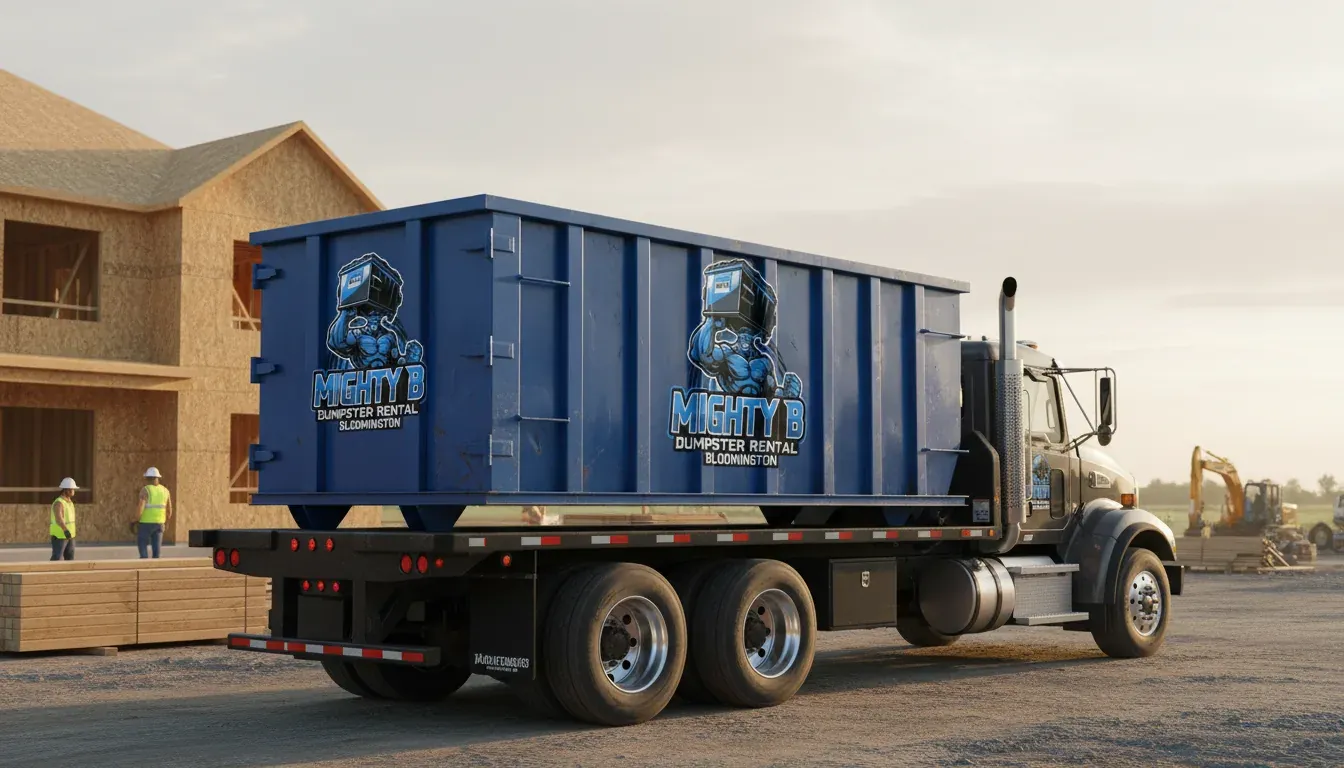
Ask ten contractors in Bloomington–Normal how they handle debris and nine will say "I just order the big one." That works right up until the job has plaster in it, or a chimney comes down, or the finish carpenter is standing in a pile of packaging with no container on site. Debris is the one line item that quietly eats schedule and margin at the same time, and it is almost entirely controllable with a plan made before demo starts.
We have been running roll-offs on McLean County job sites since 2013 — west-side remodels, gut jobs near the ISU and IWU campuses, new builds along Hershey Road, machine sheds out in the villages. This is how we would plan the containers if it were our job.
Size by the debris stream, not by the square footage
Square footage tells you almost nothing. Every container has two ceilings — the space inside it and the weight allowance built into the flat rate — and which you hit first depends on the material.
- Framing lumber and sheathing — bulky, moderately light, and it stacks terribly unless somebody cuts it down. A 20 or 30 yard runs out of room long before it runs out of tonnage. Cut long pieces at the container; do not throw 16-footers in whole.
- Drywall — deceptive. One sheet is manageable, but a house worth of board is real weight, and it swells heavier still if rain gets into an open box.
- Siding — vinyl is nearly all air and fills a container fast; fiber cement is dense and hits weight first. Do not assume "siding" behaves one way.
- Flooring — carpet and pad are pure volume, and full rolls waste more space than anything else on site unless they are cut short. Ceramic tile, thinset and mortar bed are heavy debris.
- Windows and doors — glass adds weight quickly and old wood sash is bulkier than it looks. Pull them late so glass sits on a solid base instead of getting crushed under framing.
- Roofing — asphalt shingles are the classic weight trap, filling a small container by tonnage while it still looks half empty. See our notes on roofing tear-off dumpster sizing.
- Masonry, concrete, brick and block — the densest material on any site, and the one that should almost never travel with anything else.
The general rule: size up on volume for light debris, and size down on volume while planning up on weight for dense debris. Ordering a 40 yard for a heavy load does not buy you one extra pound of allowance. Our guide on what size dumpster you need breaks down all five boxes.
Mixed C&D and clean heavy material must never share a container
This is the rule that saves contractors the most money, and the one broken most often. Mixed construction and demolition debris goes to a landfill or a C&D processing facility and is charged as mixed waste. Clean concrete, brick, block and asphalt goes somewhere else entirely — a crusher — where it becomes recycled aggregate and is priced far lower per ton because it is a feedstock, not a waste.
The instant one piece of drywall, one length of PVC or one bag of insulation lands in a clean masonry load, that load is contaminated. It is no longer recyclable aggregate. It becomes an extremely heavy mixed load and gets billed as one. Nobody sorts it back out for you.
The reverse hurts just as much. Throw broken block into a mixed C&D container and you blow the weight allowance on a box that still looks two-thirds empty. One wheelbarrow of foundation rubble can be the difference between a job that came in on the estimate and one that did not.
Keep a dedicated 10 yard for the clean masonry load
When a job has concrete, brick, block, stone or a chimney in it, plan a separate 10 yard container and call it what it is: the clean load. A 10 yard is right for heavy material because it is short and low-sided, easy to wheelbarrow into, and it reaches its weight limit at a level the truck can legally haul.
Brief the crew in one sentence: concrete, brick, block and stone only, nothing else. Not the busted bag of mortar, not the plastic sheeting used for dust control. How we handle these loads is on our concrete and heavy debris page.
Metal and cardboard: separating pays on a big job
Scrap metal is the easiest money on a construction site. Ductwork, old boilers, cast iron radiators and tubs, copper pipe, aluminum gutters, steel studs, appliance shells. On a whole-house gut in an older Bloomington neighborhood, the metal is often worth hauling to a scrap yard on its own, and every pound of it is a pound you are not paying to bury.
Clean cardboard matters most in the finish phase. Packaging from cabinets, appliances, tile, flooring and fixtures is startling once it is all in one place. Broken down flat it takes almost no room; left as boxes it fills a container in an afternoon and you pay to landfill air.
On a small job, separation is not worth the crew time. On a large one it plainly is. The break-even is roughly the point where diverting metal and cardboard eliminates one swap-out — at that point it has paid for itself. The US EPA's C&D materials guidance is worth reading if you are setting a standing policy across jobs.
Swap-out scheduling so crews never stand idle
An idle crew costs more than an extra container, every time. Three framers standing around because the box is full and the truck is two hours out is worse than the pull you were avoiding.
Two habits fix it. First, call for the swap at about three-quarters full, not when it is full. Call before noon on a weekday and we can usually get it same day; otherwise it is next morning. Second, phase the containers to the work instead of covering the whole job with one box:
- Demo — the heaviest, highest-volume phase, when plaster, tile, masonry and old flooring come out. Plan the largest box you will use, plus the clean 10 yard if there is masonry.
- Rough-in — lower volume: framing offcuts, packaging, old mechanicals and metal. Often a smaller container, or a gap with none at all.
- Finish — bulky and light. Packaging, offcuts, crates, protection material. Volume is the constraint; weight is not.
Pulling a container off site during a quiet stretch and bringing a fresh one back for finish beats letting one box sit half full for three weeks. Our construction dumpster rental is set up around this — standard rental runs seven days and extends if the phase does.
Placement, ground protection and fresh concrete
Place the container where it will still work in week four, not just on delivery day. A roll-off needs a straight approach, roughly 60 feet of run, and overhead clearance — service drops and low branches end more deliveries than tight driveways.
- Never on fresh concrete. Not a new driveway, not a new garage slab, not a new approach. Concrete must cure fully before it takes a loaded roll-off, which concentrates enormous point loads on small steel rails. If a slab was poured during your job, keep the box off it for the duration.
- Protect what you are keeping. We put boards down on every residential drop and do the same over an existing drive or apron on a build. More on protecting a driveway during delivery.
- Think about sequence. Do not park where the concrete truck or the mason's forklift needs to be next week.
Plaster and lath will wreck a volume-based estimate
West and south of downtown Bloomington the housing stock is largely pre-1940, and those walls are plaster over wood lath, sometimes over masonry. It runs two to three times the weight of modern drywall for the same wall area.
That is brutal on an estimate built on volume. A crew guts a 1,400 square foot bungalow, budgets a 20 yard "because that is what a gut takes," and hits the tonnage allowance at maybe 40 percent full. The box looks like it has room. It does not.
The fix is simple: when you see plaster, plan a smaller box and more pulls, not a bigger box. Two 15 yard containers moved through the job will nearly always beat one 30 yard sitting half full and overweight, and the lower sidewall matters when you are throwing wet, dusty plaster over it.
Treated lumber, railroad ties and awkward materials
Pressure-treated lumber from decks, retaining walls and sill plates is landfill material rather than recyclable, and must never be burned or chipped for mulch. Tell us it is in the load. Railroad ties are their own conversation — heavy, creosote-soaked, and many facilities refuse them or take them only under specific conditions. They turn up constantly here in landscape walls and farm lanes. Call before you load them; a container that cannot be tipped is worse than none at all.
Illinois landfill bans that bite on job sites
These are not haulers being difficult. They are state law, and they apply to a commercial job as squarely as to a homeowner:
- Electronics are banned under the Electronic Products Recycling and Reuse Act. On an office fit-out this is the big one — monitors, CPUs, printers and peripherals left by a previous tenant must be recycled separately.
- Landscape waste has been banned since 1990. Brush, branches, sod and leaves from lot clearing go to composting, not into your C&D box.
- Whole tires, common on rural lots and farm properties, are handled separately.
- Refrigerant-containing appliances need certified recovery first — including walk-in coolers and rooftop units, not just kitchen fridges.
- Also out: lead-acid batteries, used oil and filters, liquids, wet paint and solvents, propane tanks, and asbestos-containing material, which requires licensed abatement.
The Illinois EPA is the authority on what is prohibited, and the Ecology Action Center in Normal is the practical local hub for recycling questions in McLean County.
Documentation: scale tickets and diversion reporting
Ask for scale tickets and keep them. They record gross, tare and net weight for each load, and they prove what left the site and where it went.
- Cost control. Tickets tell you what a gut job actually weighs on your kind of house, which makes the next estimate real instead of guessed.
- Disputes. When somebody questions an overage, a ticket ends the conversation.
- Diversion reporting. If the project carries a LEED target or a public-sector waste management plan, you need tonnage by material stream and a documented recycling rate. Separated loads make that straightforward; one mixed container makes it nearly impossible to substantiate.
If your job needs diversion reporting, say so when you book. It changes the container setup from day one and cannot be reconstructed after the fact.
Winter delivery, spring thaw and unpaved sites
Central Illinois ground behaves two completely different ways. Frozen ground drives beautifully — January and February on a hard-frozen lot are among the easiest deliveries we make. Spring thaw does not. March and April on heavy clay turn raw lots and gravel lanes into something a loaded truck sinks into, and a 30 yard full of masonry will not come out cleanly.
On unpaved sites, keep a gravel or millings pad where the container sits, and site it where the truck can approach on the firmest ground available. Snow and rain also add real weight to an open container — a box left open through a wet week gains hundreds of pounds of nothing.
Container plans for three job types
| Job type | Container plan | Watch-outs |
|---|---|---|
| Kitchen or bath remodel | One 15 yard for the run of the job; 20 yard if cabinetry and flooring both come out. Add a clean 10 yard only if tile, mortar bed or a masonry hearth is involved. | Tile and thinset are heavy and hide in a "small" job. Cardboard from new cabinets and appliances fills the box at the end — break it down flat. |
| Whole-house gut | Phased: 15 or 20 yard through demo with multiple swap-outs, plus a dedicated 10 yard for chimney and foundation rubble. Smaller box or none during rough-in. Fresh 20 or 30 yard for finish. | Plaster and lath at 2–3× drywall weight blows the allowance before the box looks full. Pull metal separately. Watch for asbestos in pre-1980 flooring, pipe wrap and siding. |
| New-build lot | 30 yard through framing and rough-in with scheduled swaps; 30 or 40 yard for finish-out and packaging. Landscape waste from lot clearing handled separately — it is landfill-banned. | Keep the container off fresh slabs and the new approach. Plan for spring-thaw access, and sequence placement around concrete, lumber and mason deliveries. |
An honest word about the 40 yard
The 40 yard is genuinely useful in one situation: high-volume, low-density debris. Finish-out packaging, cardboard, insulation, cabinet crates, light demolition on a large commercial fit-out, vinyl siding and fence panels after a wind event. If you are moving a lot of air, it is the most efficient box on the truck.
It is the wrong box for anything dense. Plaster, masonry, tile, shingles, dirt, wet material — a 40 yard adds no weight allowance and gives your crew a tall wall to lift heavy debris over. It also needs the most room to deliver and dump. Big does not mean more; it means taller and longer.
Planning a build, a gut or a fit-out anywhere in McLean County? Call (309) 503-0748 before the first swing of the hammer. Tell us the phases, the materials and the site conditions and we will map out sizes and a swap schedule with you — one flat rate per container, with delivery, pickup, weight allowance, disposal and tax included. You can also reach us through the contact page.
Need a container in Bloomington or anywhere in McLean County? Call (309) 503-0748 and describe the job. We will name the size, the flat rate and a delivery slot — often the same day. No forms, no waiting on an email.