
Storm Recovery
Storm Damage Cleanup in McLean County, IL: First Steps
A practical order of operations for the morning after a Central Illinois wind or hail event: safety, documentation, adjusters, separating debris and getting a container.
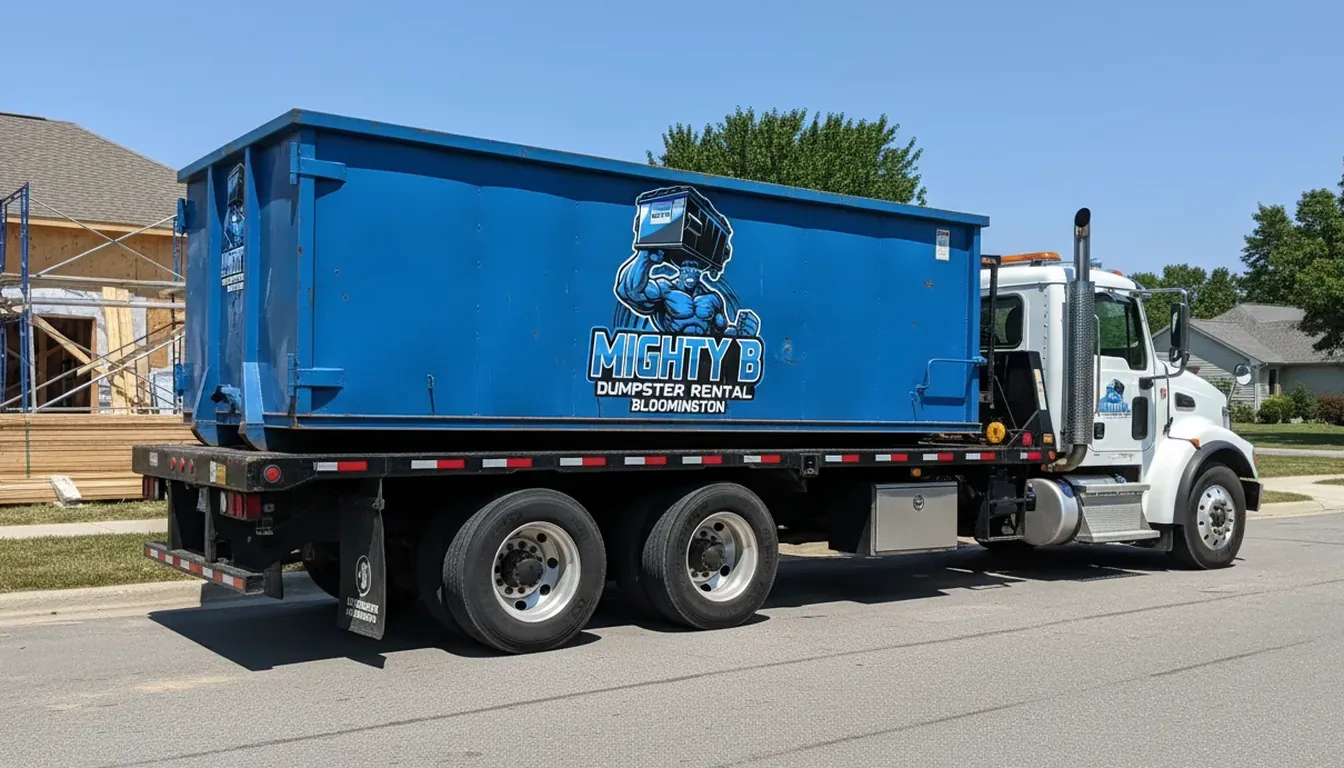
The morning after a bad one in McLean County has a particular quiet to it. No traffic, no birds, a smell of green sap and wet shingle grit, and half the street standing in their driveways looking at the same thing. You are outside in yesterday's shoes, looking at a silver maple lying across the fence and a roof that is not the shape it used to be.
We have dropped containers in Bloomington, Normal and the farm towns around them since 2013, and the day after a regional storm is our busiest phone day of the year. The cleanup is the easy part. The mistakes that cost real money happen in the first twenty-four hours.
Before you touch anything: the first twenty-four hours
Walk the property with your hands in your pockets and look for the things that hurt people after storms.
- Downed lines. Assume every wire on the ground is live, including the ones that look like cable or phone, and that anything it touches — a fence, a wet limb, a puddle, your car — is live too. Stay back the length of a school bus, keep kids and dogs in, call the utility. You do not clear this yourself, and you do not clear it "carefully".
- Your gas meter. Wind shoves trees and vehicles into meter sets and pulls service lines out of walls. If you hear hissing, smell rotten egg, or the meter looks struck or pulled off the wall, leave on foot — no switches, no starting a car in the garage — and call the gas utility from down the block.
- Structural doubt. Door frames that will not latch, a new crack running diagonally from a window corner, a sagging or stained ceiling, a garage that is now a parallelogram. If any of that is there, you do not know the building is safe. Get out and have an engineer or the building department look.
- The roof. Nobody should be on it. Hail and wind loosen decking fasteners and split rafters in ways invisible from a ladder, and wet shingle granules on a slope are ball bearings. Plenty of people survive the tornado and break a hip on Sunday. Shoot photos from the ground with a zoom, or let a roofer with fall protection go up.
- Water in the basement. Do not wade in with the power on. Heavy clay drains badly here, so a wind event often puts three inches downstairs too — its own job, covered in our flooded basement cleanout guide.
Photograph everything before you move one stick of it
This is the single most expensive mistake people make after a storm, and it is entirely avoidable. Adrenaline says clean up. Your policy says prove it.
Before anything moves, shoot the property like a crime scene. Wide shots from all four corners of the lot. Hail bruises on deck boards, AC fins and downspouts — those collateral shots are what an adjuster uses to confirm a genuine hail event when the shingle damage is arguable. Creases in the siding. Every room with water in it. The debris pile as it lies. Then video the exterior and interior, narrating as you go. Photograph the freezer contents before you throw out a steak. Keep receipts for tarps, plywood, fuel, ice and hotel nights — most policies reimburse reasonable emergency mitigation, but only against paper.
Here is the part that surprises people: an adjuster may want to see the debris in place, or at least a representative sample. If the hail-punched shingles are already hauled and the fence panels are gone, you have thrown away the evidence for your own claim. Tarp it, make it safe, photograph exhaustively, then ask your carrier one question before the container is loaded: can I dispose of the storm debris now, or do you need it on site? Get the answer in an email. Some carriers release you the moment photos are in; some do not. Ten minutes of asking beats a denied line item.
Working the claim and reading a contractor's scope
Call your carrier early. The claim queue after a regional event fills within hours, and your place in it is set by when you called, not by how bad your damage is. Get the claim number, the adjuster's name, and what mitigation they expect from you.
When contractors start knocking — and after Twin Cities hail they will, within days — a legitimate scope is written and itemised: what is removed and replaced, in squares of roofing, linear feet of fence, sheets of decking; tear-off to deck versus overlay; underlayment, ice-and-water shield, drip edge and ridge; whether damaged decking is priced per sheet; who hauls the debris and who pays for the container; a magnet sweep for nails; a start window, payments tied to milestones, and licence and insurance you can verify. Be wary of urgency, big cash deposits, offers to "cover your deductible", and any scope that folds tree work into the same line as roofing debris — in Illinois those two cannot legally ride in the same container.
A storm makes four piles, not one
Landscape waste has been banned from Illinois landfills since 1990. Trees, limbs, brush, leaves and grass are composted, not buried, and they cannot ride in a mixed roll-off with your shingles and fence panels. If they do, the load gets flagged at the scale house and you pay for it.
So sort from the first armful: green waste, building materials, household and water-damaged contents, and banned or hazardous items — four piles, four places. Sorting as you pick things up costs nothing; sorting a mixed pile a week later costs a day.
| Storm debris | In a mixed container? | How to handle it |
|---|---|---|
| Trees, limbs, brush, leaves, grass | No — banned | Own pile, own container or curbside programme |
| Stumps and root balls | No | Landscape waste, and soil-heavy — warn your hauler |
| Shingles, felt, flashing, damaged decking | Yes | Very heavy — size for weight, not volume |
| Fence panels, posts, rails, gates | Yes | Break concrete footings off the posts first |
| Siding, soffit, fascia, gutter, trim, windows | Yes | Standard C&D load; wrap broken glass |
| Shed, deck, pergola, garage framing | Yes | Cut to length so it lies flat |
| Wet drywall, insulation, carpet and pad | Yes | Bag it and go — it gains weight daily |
| Concrete footings, brick, chimney rubble | Separate load | Clean heavy-debris container, filled low |
| Freezer or fridge killed by the outage | No, not as-is | Refrigerant recovery first |
| Water-wrecked TVs, computers, electronics | No — banned | Illinois e-waste law; recycle separately |
| Generator fuel, chainsaw mix, old oil, solvents | No | Household hazardous waste, never a container |
| Propane tanks, whole tires, car batteries | No | Retailer take-back or HHW |
| Anything touching a downed wire | No | Leave it. Utility only. |
The Ecology Action Center in Normal is the first stop for that banned column — the recycling and household hazardous waste hub for McLean County.
Municipal storm-debris pickup: useful, limited, on its own clock
After a declared event, municipalities often stand up a special curbside storm-debris collection. Worth using; not a whole-cleanup solution. These programmes typically take vegetative debris only — storm-downed limbs and brush, stacked at the curb, cut to a stated length, butt ends to the street, clear of the sidewalk, gutter line and hydrants. They typically do not take construction debris: shingles, fence, siding, drywall, insulation, carpet, contents, appliances, or anything a contractor generated. Mix the two and the crew usually drives past the whole pile.
Then the timetable. These run by ward, zone or route with a published window and a hard cutoff, and after a wide event one pass across a town can take weeks. Check the source — the City of Bloomington, the Town of Normal, or McLean County if you are outside the Twin Cities. Rural properties on township roads often have no programme at all, which is why farm places nearly always rent.
Containers get scarce fast. Get in the queue on day one.
A derecho or a tornado track does not damage one house, it damages a corridor of them. Every roofer, tree service and homeowner between here and the interstate calls in the same forty-eight hours, and inventory is finite. Roll-offs also sit longer after storms, because people are waiting on adjusters — the fleet turns over more slowly exactly when demand triples.
So book before you are ready, and say what you are facing: roof only, whole property, tree work, or all three. Moving a delivery date is easy; finding a container from a standing start in week two is not. Storm debris cleanup and yard waste removal after a wind event are usually two deliveries to the same address.
Sizing: roof-only versus whole property
Roof only. Shingles are dense, and that weight fills a small container long before it fills a big one. A 20 yard is the usual answer; our roofing dumpster rental page works through the square-count maths.
Whole property. Roof plus fence plus siding plus a shed plus soaked basement contents is a volume problem, not a density problem — bulky, awkward, always more than anyone estimates. That is 30 yard territory, and on farm places with outbuildings a 40 is not unusual. When in doubt, size up: a second haul costs a second rental, while unused space costs nothing. Tree and brush get their own container regardless, because of the ban.
Placement when the driveway is blocked and the yard is soup
Storm sites are the worst placement conditions we work in: the driveway part-occupied by a limb nobody can move yet, the lawn saturated. Clear a straight approach and a landing zone before the truck comes, and tell us the truth about ground conditions on the phone. A roll-off needs roughly sixty feet of straight backing room, about twenty-three feet of clear length for the box, and fourteen feet of vertical clearance — which after a storm means checking for the low branch and the sagging service drop that were not there last week. We put protection boards under every residential drop. What we will not do is run a loaded truck across a soft lawn; it will rut to the axle. If the drive is unusable, the options are a street placement — which may need a permit, see the permits guide — or a day's wait for the ground to firm.
The freezer, and the smell that follows
After a multi-day outage the chest freezer in the garage is a real disposal problem. Photograph the contents first — many policies cover food spoilage up to a limit, and no photo means no payment. Then double-bag and tie hard. A roll-off is not a sealed dumpster, and warm protein sitting in one for days in August draws every raccoon and fly around. Small volumes of bagged food waste are fine; a whole freezer's worth needs staging and haul timing talked through. And if the freezer itself is dead, it holds refrigerant that must be professionally recovered first.
Wet materials and the mould clock
Water that came in through a torn roof or a broken window starts a clock, and it runs in days, not weeks. Warm, humid Central Illinois air makes it faster. Wet insulation does not dry in the cavity — batts hold water against the framing and lose their R-value permanently, so it comes out. Drywall wicks well above the visible line; cut a foot or two above the highest water mark. Carpet pad is a sponge. Carpet itself is sometimes savable if it is clean water and it is lifted, extracted and dried within a couple of days; if it sat, it goes. Pull baseboard, open the cavities so air moves through, and run fans and a dehumidifier continuously. All of it is fine in a standard container, but it gets heavier every hour it sits. Photograph the water line before you cut.
Generators and fuel
Every storm season produces carbon monoxide deaths in the Midwest and every one was preventable. A generator runs outdoors only — not in the garage with the door up, not on the porch, not in a shed, not under an open window. Fifteen to twenty feet out, exhaust pointed away, working CO alarms inside on every level. Let it cool before refuelling; hot exhaust and spilled fuel is how garages burn. Never back-feed a generator into a wall outlet — it energises the utility line and can kill the lineman restoring your power. And leftover fuel, old chainsaw mix and used oil do not go in the container; that is a household hazardous waste trip.
Call us early
Storm weeks are the one time in this business where a smooth cleanup and a miserable one are decided by a phone call on day one. Ring (309) 503-0748, tell us what happened and whether you have trees, building debris or both, and we will get you in the queue for the right container — one flat number covering delivery, pickup, weight allowance and disposal, protection boards down when we drop. We cover Bloomington, Normal and the farm towns across McLean County, and after a bad night we are usually already rolling.
Need a container in Bloomington or anywhere in McLean County? Call (309) 503-0748 and describe the job. We will name the size, the flat rate and a delivery slot — often the same day. No forms, no waiting on an email.